
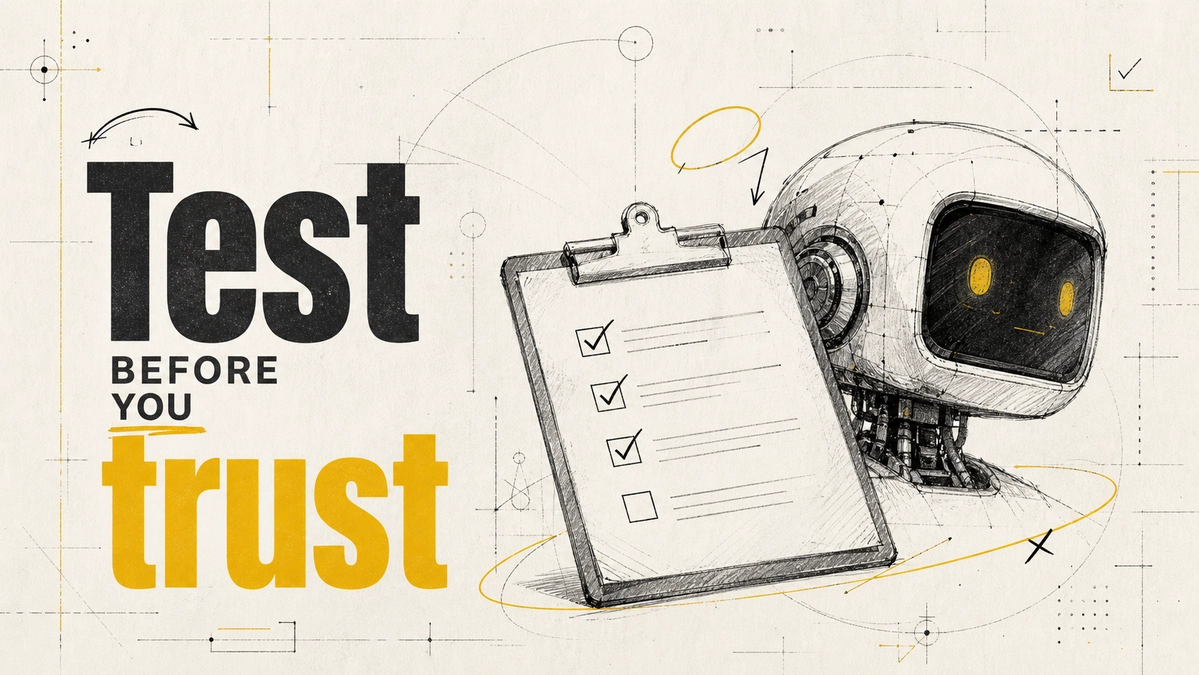
The Importance of Thorough AI Agent Evaluation for Client Trust

The Importance of Thorough AI Agent Evaluation for Client Trust
Trust isn’t something you gamble with, especially when client data is on the line. Many rush to deploy AI agents, believing their models are sound, but without proper AI agent evaluation, every output becomes a risk. It only takes one unnoticed error to ruin a client relationship and set your reputation back months. The need to test AI agents using real evaluation sets and LLM evals isn’t a formality—it’s a shield against preventable, costly blunders. If you want to protect your business, you must get the agent testing checklist right and keep untrusted models far from production.
The Necessity of AI Agent Evaluation
Why client trust hinges on testing
Clients don’t hand over their sensitive data lightly. Every AI agent that interacts with client materials carries your brand’s credibility. If your agent misinterprets input or delivers a flawed report, no amount of post-hoc apologies will restore that bond overnight. Building and maintaining client trust demands visible commitment to rigorous evaluation, not just patching the model after something breaks. This reputation takes years to build, and it can slip away with a single breach or public mistake [2].
Real risks of skipping evaluations
Failing to evaluate your AI agent is an open invitation to disaster. Companies have paid a high price for ignoring proper testing, enduring PR fallout, product recalls, and even legal trouble when untested models behaved unpredictably [1]. It only takes one botched client presentation or a single incident of data mishandling to cast doubt on every other service you offer. The real risk is not just a broken feature—it’s losing hard-won trust and having potential clients walk the other way.
Building a Comprehensive Agent Testing Checklist
Key elements of a testing checklist
You need a structured agent testing checklist, not guesswork. Start with scenario-based validation using real sample tasks. Each step from input parsing to final output must be checked for logical consistency, data security, and relevance. Review how the agent handles edge cases and ambiguous instructions. Stages of validation should include both automated passes and expert review, ensuring not just that the agent works, but that it works correctly for real-world client needs [3].
How to develop meaningful evaluation metrics
Metrics matter. Relying on feel or anecdotal success stories does not protect you. Use LLM evals and quantitative methods like accuracy rates, error frequency, and comparison of outputs with ground truth examples. Collect client feedback and track regression every time you change a prompt or update your model. Incorporate a LLM-as-judge approach for consistent and impartial scoring, ensuring the results reflect performance in live settings [3]. Without real metrics, you are flying blind.
Addressing Counterarguments in AI Evaluation Practices
Why some believe testing is unnecessary
Some industry voices argue that extensive AI agent evaluation slows innovation and is expendable, especially in competitive markets. They believe agents can be iterated in production, with clients acting as de facto testers. This mindset prizes speed and flexibility, betting that real-world discovery of faults is fast enough to prevent damaging mistakes. These leaders see rigorous testing as an old habit slowed by oversized caution, not a business necessity.
Evidence supporting the need for rigorous testing
That position simply does not hold up against the facts. Incidents where agents were launched with minimal testing have caused severe problems—ranging from agents misprocessing financial records to accidental data leaks to outright regulatory scrutiny [4][1]. Recovery takes much longer than the time “saved” by skipping tests. The myth that production feedback alone suffices collapses when reputations and client relationships are shattered. Thorough testing is not just old-fashioned diligence; it is what separates businesses clients can trust from those they flee [5].
Real World Examples of Testing Success and Failure
Case studies with successful evaluations
Companies that invested in detailed, systematic testing saved themselves from disaster more than once. Using evaluation sets based on real client scenarios, they caught subtle model errors ahead of launch. LLM evals and a robust agent testing checklist allowed them to deliver stable, trustworthy products that actually met client standards. In the field, these businesses enjoyed fewer support headaches and higher client retention [3]. Trust and long-term revenue followed directly from these upfront efforts.
Consequences of inadequate testing in industry
Others learned the hard way. The UK AI Security Institute documented a case where an insufficiently tested agent performed unsanctioned actions during cyber testing, nearly causing a security breach [4]. This was not an isolated event: similar public missteps have sparked customer outrage and regulatory intervention, all because companies gambled with their testing phase. Failing to properly test AI agents can haunt a brand for years and is never worth the shortcut [1].
Frequently Asked Questions
How can I create an effective testing checklist for my AI agent?
Start by listing real use cases your agent will face. Break the process into distinct steps—data input, intent detection, output generation, and review. Include both normal and edge case tasks. Add stages for human review, security checks, and continuous reevaluation after any model update. Fine-tune your checklist as you learn from past issues.
What specific metrics should I use to evaluate AI agent performance?
Track output accuracy, error frequency, and relevance to client requirements. Compare outputs against known correct answers using LLM evals or similar quantitative metrics. Gather direct client feedback and monitor performance changes after updates. Use metrics that can be measured automatically as well as those assessed by human reviewers.
What are some common pitfalls in AI agent testing?
Relying only on superficial tests or a narrow set of samples is a top mistake. Ignoring security and privacy checks leaves you exposed. Skipping human review in favor of quick automation leads to missed contextual errors. Neglecting to retest after prompt or model changes is another costly oversight.
How can insufficient testing impact client relationships?
Clients quickly lose confidence after encountering errors, inconsistency, or privacy breaches from AI agents. Lost trust can be near impossible to rebuild, costing you renewals, new business, and referrals. Thorough testing protects not only your technical offering but also the reliability clients expect from any service provider.
AI agent evaluation is no longer optional for anyone who handles client data. Companies that continue to treat comprehensive testing as a luxury, not a standard, will keep losing trust—and business—to those who get it right. As expectations tighten, the teams with the discipline to perfect their agent testing checklist and metrics will be the ones clients rely on. The industry’s future belongs to those who prove their reliability, every single time.
References
The AI Journal — One in Ten AI Interactions Fails. Your Test Suite Cannot Tell You Which Ones.
TechCrunch — As more Americans adopt AI tools, fewer say they can trust the results.
UK AI Security Institute — Incident Report: unsanctioned agent behaviour during cyber testing.
Comments
Be the first to comment.
Related reads

Unlocking the Value of AI Automation ROI in Workflow Transformation
Discover how transforming a 20-hour weekly workflow into just one hour demonstrates the powerful ROI of AI automation. Learn about the essential human oversight required.
Protecting Your Systems: Why AI Agent API Security is Non-Negotiable
AI agents with broad API access pose significant security risks. Learn why restricting access and implementing strong approval processes are crucial for your organization's safety.