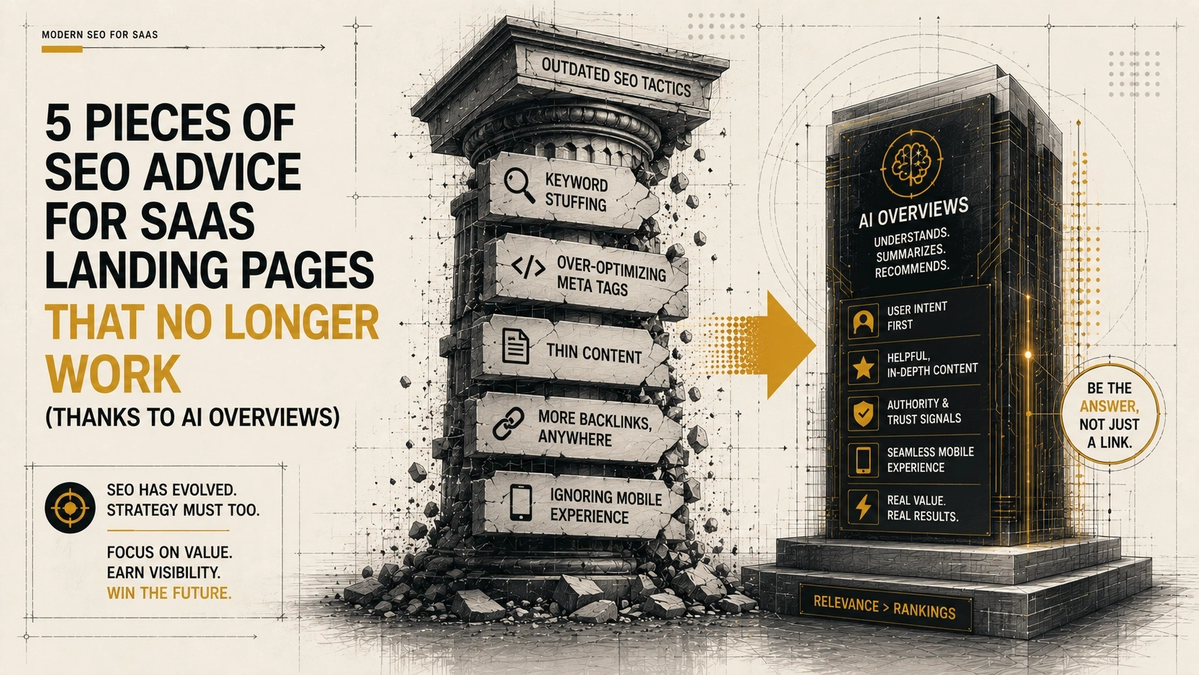
5 pieces of SEO advice for SaaS landing pages that no longer work (thanks to AI overviews)

Google AI Overviews now appear on many tracked queries and slash organic click-through rates by up to sixty-one percent.[1] SaaS landing pages that followed old ranking playbooks lose traffic even when positions hold.
The five SaaS SEO tactics below no longer deliver results. Agencies and freelancers who keep using them waste effort while competitors adapt to citation and zero-click reality.
Ranking for Broad Informational Keywords No Longer Drives Visits
Targeting high-volume terms such as what is CRM or how project management software works once filled the top of the funnel. AI Overviews now answer those queries directly. Organic CTR on affected informational searches fell from one point seven six percent to zero point six one percent.[1] Independent reporting also found large traffic declines for some informational content libraries as AI-generated answers reduced clicks.[4] SaaS landing pages built around these keywords receive far fewer visitors. Shift focus to commercial and branded terms that still generate intent.
Recent tracking shows AI Overviews trigger on a large share of searches, with informational queries seeing the heaviest coverage.[6] A SparkToro analysis of Similarweb data found sixty-eight percent of US Google searches ended with no click at all in early 2026.[2] That rate climbed from sixty point four five percent two years earlier.[2] Pages built only for broad educational terms now feed answers that never leave the results page.
Meta Description Optimization for Traditional CTR Has Lost Impact
Writing clever meta descriptions to lift click rates from blue links was standard practice. AI Overviews push organic results down and raise zero-click searches. Even strong position one pages lose roughly fifty-eight percent of expected clicks when an overview appears.[1][3] Descriptions still appear in some results but no longer move the needle enough to justify heavy optimization time. Structure the page itself so AI systems extract clear answers instead.
Ahrefs measured that drop across three hundred thousand keywords.[3] Position one CTR fell about fifty-eight percent when an overview showed.[3] The description field still exists in the code, but the visible result sits lower. Direct answer blocks and FAQ sections give the systems clean text to pull. That work produces more citations than any rewrite of the meta tag.
Exact-Match Keyword Placement No Longer Secures Rankings
Stuffing the primary term into the title tag, H1, and opening paragraph once signaled relevance. Search systems now understand semantics and user intent far better. Exact-match tactics produce awkward copy that AI Overviews ignore in favor of natural structured explanations. SaaS pages that force keywords rank no better and convert worse. Write for the buyer question first and let natural language carry the signals.
Semantic matching rewards clear entity signals and original frameworks. Pages that answer the real commercial question in plain language earn more overview mentions. Forced keyword density creates copy that both buyers and extraction systems skip.
Scaling Thin Comparison and Best-Of Pages Delivers No Lasting Value
Publishing dozens of product-versus-product or best-tools listicles was a common SaaS growth tactic. These pages offer little original value and get summarized or bypassed by AI Overviews. Multiple sites that scaled this approach lost substantial organic traffic in recent updates.[4] Landing pages need unique data, original frameworks, or genuine customer proof. Generic comparisons no longer justify the production cost.
One clear example is the HubSpot blog itself. Independent tools recorded a large drop in organic visits to that property.[4] The content library leaned heavily on high-volume educational and comparison pieces. AI systems summarized the same points without sending the click. Sites that replaced thin lists with proprietary data or customer results held more of their traffic.[4]
Chasing High Volumes of Backlinks Misses the New Authority Signals
Accumulating large numbers of links once built domain authority for rankings. AI citation systems place greater weight on structured data, original research, and clear entity signals than on link quantity alone.[5] Pages with strong AggregateRating schema and citable statistics earn more overview mentions. Link volume without those elements fails to protect traffic. None of that matters, though, if the crawler cannot read the page in the first place. Client-side rendered pages routinely delay or block indexing of the same structured content that AI citation systems are supposed to pick up, so the technical foundation has to come before the schema work. Build authority through verifiable expertise and machine-readable markup instead.
Structured markup such as AggregateRating and FAQPage gives extraction systems ready-made facts. Research on citation patterns shows pages carrying these elements appear more often in overviews than pages that rely only on link counts.[5] Original numbers and customer proof supply the text the systems quote. Link building still helps crawl and trust, but it no longer sits at the center of the strategy.
Ranking Still Matters Is an Incomplete Defense
Some claim traditional rankings remain essential because cited pages often rank well and commercial SaaS queries face lighter AI Overview coverage. Rankings alone no longer guarantee clicks. Position one pages still lose more than half their traffic when overviews appear.[1][3] SaaS buyers increasingly start research inside AI tools. Pages must earn citations through structure, unique information, and schema or the ranking becomes an empty victory. Adaptation beats clinging to the old playbook.
The counterargument holds partial truth for commercial and branded queries. Those searches trigger overviews less often than pure informational ones.[6] A page that ranks first for a high-intent product term still collects clicks. Even those wins shrink when an overview appears. Seer Interactive data shows organic CTR on overview queries dropped sixty-one percent from mid-2024 to late 2025 before a partial rebound.[1] Cited brands recovered more clicks than uncited ones, but the overall volume stayed lower.[1] Rankings open the door. Citations and structure decide whether anyone walks through.
| Query Type | Typical Overview Trigger Rate | CTR Impact When Overview Appears |
|---|---|---|
| Informational | High (often 60 percent-plus) | Drop of 58-61 percent |
| Commercial / Transactional | Lower (under 10-20 percent in many sets) | Smaller drop, still measurable |
| Branded | Lowest (around 13 percent) | Often neutral or positive for the brand |
The table shows why pure ranking defense falls short. Commercial terms still reward position, but the page must also supply extractable answers and proof to stay visible inside the overview itself.
FAQ
Do any traditional on-page SEO elements still help SaaS pages?
Clear titles matching intent, fast load times, and logical heading structure still support both rankings and AI extraction. They work as foundations, not as complete strategies.
How should SaaS landing pages adapt to AI Overviews?
Add direct answer blocks, FAQ schema, and original statistics. Focus on commercial and comparison queries that still drive clicks and citations.
Is branded search a safe haven for SaaS traffic?
Branded queries face fewer AI Overviews and sometimes gain clicks. Strengthen brand presence so buyers search your name after AI research.
Can thin content ever recover under the new system?
Rarely. Consolidate weak pages into deeper resources with unique data. Redirects and stronger internal links help more than refreshes of the same thin material.
What metric replaces organic traffic volume?
Track AI citations, demo requests from AI-referred visits, and commercial query performance. These show real pipeline impact better than raw sessions.
Why do some SaaS pages still rank but lose most clicks?
An overview sits above the organic results and answers the query on the page. Position one still appears, yet most users never scroll to it.
SaaS teams that abandon these five tactics and build for extraction and citation capture the remaining high-intent traffic. The search landscape keeps shifting toward answers that need no click. Only pages built for that reality keep delivering customers.
- Seer Interactive. AIO Impact on Google CTR 2026 Update. https://www.seerinteractive.com/insights/aio-impact-on-google-ctr-2026-update
- SparkToro. In 2026, Less than One Third of Google Searches Still Send a Click. https://sparktoro.com/blog/in-2026-less-than-one-third-of-google-searches-still-send-a-click/
- Ahrefs analysis referenced in multiple 2026 CTR studies, including position-one impact. https://www.seerinteractive.com/insights/aio-impact-on-google-ctr-2026-update
- HubSpot. Did HubSpot Really Lose 80% of Blog Traffic? https://blog.hubspot.com/marketing/blog-traffic-loss-explainer
- Search Engine Land. Google AI Overviews drive 61% drop in organic CTR. https://searchengineland.com/google-ai-overviews-drive-drop-organic-paid-ctr-464212
- Similarweb data via SparkToro and Search Engine Roundtable on AI Overviews prevalence. https://www.seroundtable.com/half-google-searches-ai-overviews-41780.html
Comments
Be the first to comment.
Related reads
When Not to Automate: Understanding AI Automation Limitations
Automating a broken process only accelerates failure. Before implementing AI, it’s crucial to stabilize operations, define accountability, and assess risks.
Preparing Your Team for Web AI Design Shifts: Prioritizing User Experience
In the face of rapidly evolving AI and web design technologies, prioritize user experience over simply adopting the latest tools. Discover how to prepare your team for these essential shifts.