
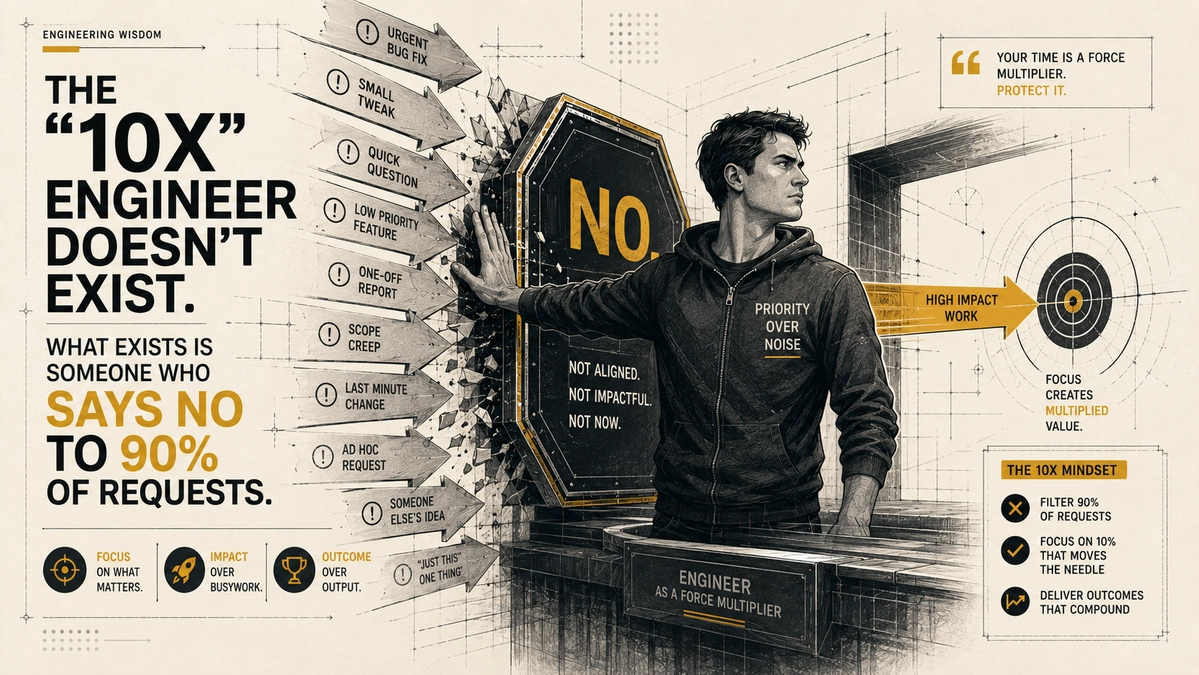
The "10x engineer" doesn't exist. What exists is someone who says no to 90% of requests

The 10x engineer myth hides the real driver of high output. Learn how protected focus, fewer interruptions, and saying no lead to stronger engineering results.
Context Switching Destroys More Output Than Talent Gaps
Knowledge workers lose up to forty percent of productive time to context switches [2][8]. Recovery after each interruption averages twenty-three minutes [2]. A team of twelve can lose more than nine hours of productive capacity every day [2]. Developers typically spend only one to two hours each day writing new code [3]. The rest disappears into meetings, reviews, and recovery. Protecting those few deep-work hours multiplies real output far more than any natural speed advantage.
Measured recovery after a significant switch sits at twenty-three minutes [2]. Across a twelve-person team, the daily loss exceeds nine hours [2]. Median daily coding time for many developers lands near seventy-eight minutes once meetings and switches are counted [3]. The remaining hours vanish into recovery and low-value tasks.
| Switches per Day | Lost Time per Engineer | Team of 12 Daily Loss |
|---|---|---|
| 3 | ~1 hour | ~12 hours |
| 4–5 | 1.5–1.8 hours | 18–22 hours |
| 6+ | 2+ hours | 24+ hours |
These figures draw from team tracking of recovery costs and project switches [2][8]. The productivity cost compounds faster than any individual coding speed can offset.
The Original 10x Claim Rests on Weak Evidence
The famous ratio traces to a 1968 study of twelve programmers working on isolated tasks [1][4]. Modern measurements inside real teams show spreads closer to two or three times when experience and environment are similar [5][9]. Much of that gap disappears once interruptions and unclear priorities are controlled. The image of a lone genius who ships miracles while ignoring the team creates bottlenecks and technical debt instead of better outcomes.
The 1968 Sackman study measured small, isolated problems under conditions far removed from today's collaborative software teams [1][4]. Later reviews note that the sample size, task type, and lack of team context limit its relevance [1][4]. Controlled modern data places typical performance differences closer to two or three times when the environment stays consistent [5][9].
Saying No Creates the Space for High-Value Work
Engineers who decline most feature requests, meetings, and side tasks keep their attention on the few efforts that move the product. One entrepreneur closed a major deal by refusing a client demand for a private list [6]. Revenue later tripled after he made no the default answer [6]. Design leaders who stopped accepting every project report stronger teams and better margins [7]. The refusal itself becomes the productivity tool.
Clear refusal based on capacity or impact protects the deep hours that produce finished work. Teams that normalize selective yes avoid the scattered effort that turns into technical debt and delayed releases [6][7].
Talent Alone Does Not Explain the Difference
Some still argue that rare domain experts and influential engineers deliver ten times the value. Domain knowledge and communication skill matter. Yet those advantages only compound when the person can say no to distractions. Without protected focus, even strong talent sinks into the same meeting and interruption costs that limit everyone else. Environment and selection determine whether talent appears many times larger.
Domain expertise and influence create real leverage. That leverage still depends on the ability to protect attention. Strong talent without the daily practice of refusal falls into the same recovery cycles that constrain average performers. The environment multiplies or cancels the individual difference.
Teams That Normalize Refusal Ship More Reliable Work
When every engineer feels free to decline low-impact work, the whole group avoids scattered effort. Code reviews stay focused, documentation stays current, and technical debt stops growing from rushed, half-built features. Agencies and product teams that measure success by finished outcomes rather than activity volume consistently outperform those that celebrate constant availability [6]. The culture of selective yes produces the results people wrongly attribute to mythical individuals.
Shared priority lists and protected focus blocks turn refusal into a group norm. Finished outcomes rise while activity metrics lose their false appeal. Reliable delivery replaces the appearance of constant motion.
Focus Becomes the Real Competitive Edge
Protecting deep work is the practical path available to any skilled engineer. Calendar blocks, written priorities, and clear refusal scripts turn ordinary capacity into stronger delivery. The market continues to reward people who finish the important work rather than those who accept every request that arrives.
FAQ
Does saying no damage career progress?
Clear professional refusal based on capacity or impact usually earns respect. Chronic overcommitment leads to lower quality and burnout that hurt careers more. Documented priorities make the refusal easier to defend.
How do I decide which ninety percent to refuse?
Rank requests by direct impact on current goals and by the recovery cost they impose. Decline anything that fragments focus without a clear return. A short written priority list keeps the decision consistent.
Can a whole team adopt this approach?
Yes. Shared priority lists and protected focus blocks make refusal a team norm rather than an individual risk. Leaders who model the practice remove the fear that saying no will stand out.
Is there any place for the classic 10x coder idea?
Individual speed differences exist, but they are smaller and less reliable than the gains from consistent focus. Systems beat heroes. The larger multiplier comes from protected attention across the group.
What replaces the 10x hiring myth?
Hire for the ability to prioritize and protect attention. Then give those people the conditions that let focus compound. Environment and selection matter more than searching for mythical individuals.
How do interruptions affect code quality as well as speed?
Recovery after a switch raises the chance of introducing defects [10][11]. Teams that reduce interruptions report higher throughput and fewer defects that later demand rework [10][11].
Engineers who treat their attention as the scarcest resource deliver the results others chase through longer hours. The difference is not superhuman talent. It is the daily practice of saying no.
References
[1] CodeIntelligently — The Myth of the 10x Developer: https://codeintelligently.com/blog/myth-of-10x-developer
[2] SignalsAI — Cost of Context Switching for Engineering Teams: https://orgsignals.com/blog/cost-of-context-switching-engineering
[3] PanDev Metrics — How Much Time Developers Actually Code: https://pandev-metrics.com/docs/blog/how-much-developers-actually-code
[4] Beyond Runtime — It Is Time to Bury the 10x Engineer: https://beyondruntime.substack.com/p/its-time-to-bury-the-10x-engineer
[5] Jeremy Knox — The 10x Engineer Myth: https://www.jeremyknox.ai/blog/the-10x-engineer-myth/
[6] DevOps.com — Want a Successful Software Build, Just Say No: https://devops.com/want-a-successful-software-build-just-say-no/
[7] Business of Home — How This Designer Found Success When She Stopped Saying Yes: https://businessofhome.com/boh/article/how-this-designer-found-success-when-she-stopped-saying-yes-to-everything
[8] Sugarbug — The Cost of Context Switching: https://sugarbug.ai/blog/cost-of-context-switching
[9] IEEE Spectrum — In Praise of Normal Engineers: https://spectrum.ieee.org/amp/10x-engineer-2671288905
[10] CodeIntelligently — Cost of Context Switching for Devs: https://codeintelligently.com/blog/context-switching-developers-cost
[11] ShiftMag — The Cost of Interrupting Developers: https://shiftmag.dev/do-not-interrupt-developers-study-says-5715/
Tags
Comments
Be the first to comment.
Related reads
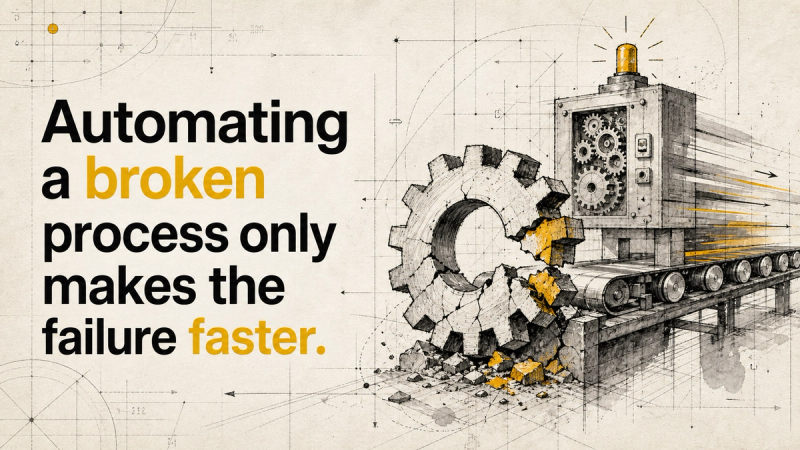
When Not to Automate: Understanding AI Automation Limitations
Automating a broken process only accelerates failure. Before implementing AI, it’s crucial to stabilize operations, define accountability, and assess risks.

Preparing Your Team for Web AI Design Shifts: Prioritizing User Experience
In the face of rapidly evolving AI and web design technologies, prioritize user experience over simply adopting the latest tools. Discover how to prepare your team for these essential shifts.