
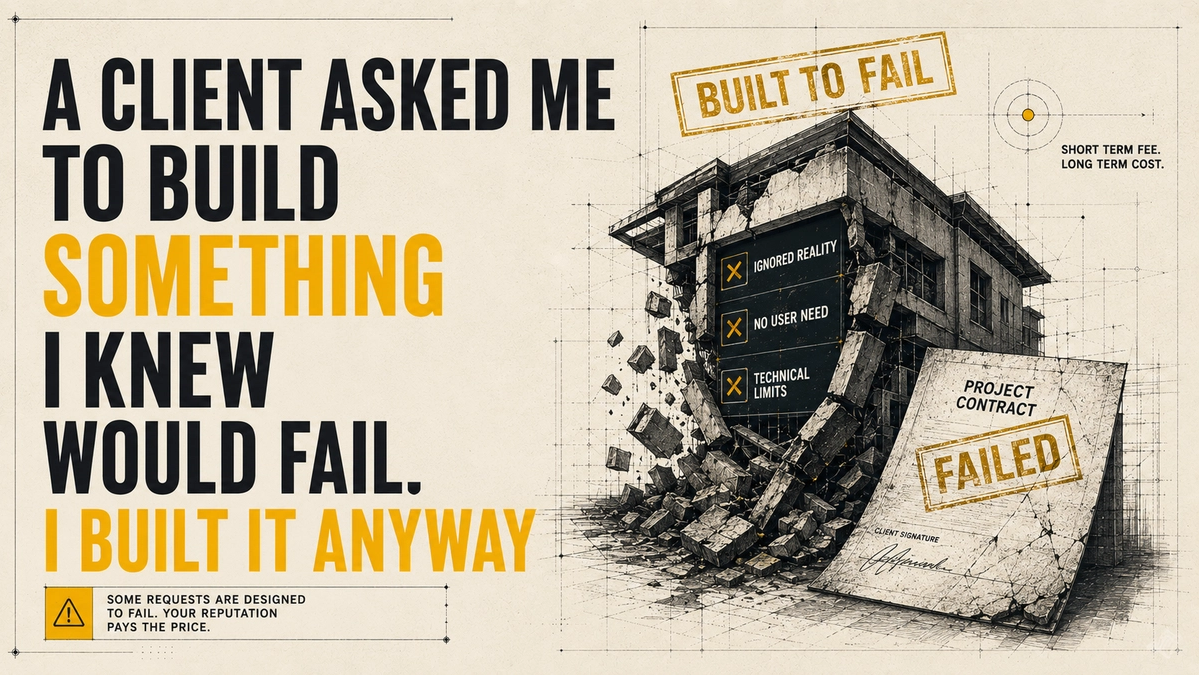
A client asked me to build something I knew would fail. I built it anyway

Building doomed client projects hurts your reputation and profits. Learn why freelancers should refuse risky work backed by project data and real examples.
Project Failure Rates Leave Little Room for Doubt
Standish Group data shows thirty-five percent of projects succeed, while forty-six percent finish late, over budget, or incomplete, and nineteen percent fail outright [1]. Complex projects fail at nearly twice the overall rate. Agencies already lose one thousand to five thousand dollars monthly on unbilled work tied to poor scoping [3]. When you accept a request you know cannot work, those losses compound. The numbers show that requests ignoring core constraints often end in wasted effort.
Later tracking keeps the same picture. A Standish CHAOS Report summary places success near thirty-one percent, with half the projects challenged and nineteen percent cancelled or unused [1]. Small projects succeed far more often than large ones. The gap widens fast once complexity rises.
| Project Size | Success Rate | Challenged Rate | Failure Rate |
|---|---|---|---|
| Small (under $1M) | 62% | 25% | 13% |
| Medium ($1M - $10M) | 36% | 43% | 21% |
| Large ($10M - $100M) | 14% | 56% | 30% |
| Mega ($100M+) | 6% | 61% | 33% |
These bands come from Standish size data across reports [1]. The drop grows steeper as scope and size increase.
Your Name Stays Attached to the Failure
Clients move on after a failed launch. You carry the review and the portfolio entry. One designer accepted a twenty-five-hundred-dollar mobile screen project despite clear leadership conflicts and shifting visions. The work stretched to more than ten screens across three weeks. The client left a one-star public review [2]. That single mark costs future clients who search your name. Reputation recovery takes longer than the original fee covers.
The same pattern appears in other accounts. A designer took a low-budget screen job under pressure and watched leadership conflicts multiply the screens. The public one-star mark stayed visible long after the payment cleared [2]. Future buyers read those marks before they reach out.
Short-Term Fees Hide Long-Term Losses
A founder pays a freelancer ten thousand dollars for an MVP that arrives broken. Rescue work then costs fifteen to thirty thousand dollars more [5]. The original builder rarely sees the second payment and often faces disputes. Agencies report that seventy-eight percent rarely bill for the extra hours that follow flawed requests [3]. Accepting doomed client projects turns a quick invoice into unpaid cleanup and lost capacity for solid work. Most of this traces back to what happens before the first invoice, not after. Our client onboarding checklist breaks down how a structured intake process catches these red flags before you've committed to the doomed scope.
Ignition data shows fifty-seven percent of agencies lose one thousand to five thousand dollars each month to unbilled work. Another thirty percent lose more than five thousand. Seventy-eight percent rarely charge for the extra hours [3]. The first fee never covers the second wave of cost.
The Client Pays Argument Ignores Your Exposure
Some freelancers claim the buyer holds all risk, so they should simply deliver the request. That view fails in practice. Payment often stops when the product fails to perform. Eighty-five percent of freelancers experience late payments, and twenty-nine percent of invoices arrive past due [4]. A failed delivery gives the client an easy reason to withhold funds. Your time and reputation absorb the hit while the client searches for the next builder.
Late payment data from multiple surveys keeps the same range. Nearly half of small business invoices sit overdue for more than thirty days [4]. Freelancers spend more than one hundred hours a year chasing funds that should have arrived on time [4]. A broken product hands the client a ready reason to delay further.
Why Some Still Argue for Taking Every Request
A frequent counterclaim says every yes builds the portfolio and keeps cash moving. Supporters note that early low-rate work opens better doors later or that empty weeks hurt more than a flawed delivery. The view sounds practical when bills are due.
The claim collapses under the numbers. Portfolio entries tied to failed launches repel the clients who pay well. One public one-star review outweighs several quiet successes in search results. Empty weeks have free capacity for solid work that produces referrals. Agencies that pack calendars with known risks report higher rates of delayed hiring and thin margins [3]. The short cash rarely offsets later disputes, unpaid cleanup, and lost referrals. The exposure lands on the builder, not the buyer.
Push Back Creates Better Outcomes for Both Sides
Present the clear limits and offer a revised scope that can succeed. Packaging your services into fixed-price, defined-scope offers makes this easier before the conversation even starts. Many clients adjust once they see the data. Those who refuse reveal themselves as poor fits. One developer spent nine months on a large custom system that lacked proper architecture [6]. The client ended the relationship after the project fell short of a working product. Early refusal saves months and preserves the relationship for future viable work.
Fixed-price offers with clear boundaries force the talk toward what can ship. Clients who accept the revised path leave with a product that works. Those who walk away free your calendar for buyers who value results.
Capacity Filled with Failures Blocks Real Growth
Every doomed client project occupies hours that could go to reliable buyers. Agencies with unpredictable cash flow delay hiring and investment plans at high rates [3]. Filling the calendar with known failures keeps utilization low and margins thin. Selecting only viable requests raises the success rate of your own portfolio and attracts clients who value results.
Unpredictable cash flow forces many agencies to pause growth plans [3]. Scope creep that stays unbilled locks hours that could support stable clients and steady hiring. Choosing only viable requests lifts the success rate of the work you keep.
FAQ
How do I know a project is doomed before I start?
Look for requests that ignore technical constraints, user research, or realistic timelines. When the client dismisses your concerns about those limits, the risk is clear. Written notes of those early talks create a record you can return to later.
What if the client insists the idea will work despite the data?
Present the specific failure points in writing and quote the cost of the safer alternative. If they still demand the original path, decline the work. A short email that restates the risks protects both sides.
Does refusing hurt my pipeline?
It frees time for projects that succeed and generate referrals. Failed deliveries damage the pipeline more than an empty week. Buyers who search your name after a public failure rarely return.
Can I build a limited version to prove the problem?
Only if the limited version stays within a paid discovery phase with clear exit terms. Free or open-ended tests rarely convert into viable projects. Paid discovery keeps the relationship clean and the risk shared.
How do I document the refusal for protection?
Send a concise email that restates the risks and the alternative you offered. Keep the record so any later claim of non-delivery has a clear trail. The same email often becomes the start of a later successful engagement with a different client.
What if I already began work that now shows clear failure signs?
Stop new work and present the evidence in writing with a revised path or an exit plan. Continuing without change locks in the same losses the data already predicts. Early course correction still costs less than a full rescue later.
Freelancers who treat every request as optional protect the quality of their output. The market continues to reward those who deliver working results over those who simply complete the brief.
References
[1] Standish Group CHAOS Report data via BudgetOverrun and OpenCommons: https://budgetoverrun.com/studies/standish-chaos-report and https://opencommons.org/CHAOS_Report_on_IT_Project_Outcomes
[2] Medium — My First 2500 Freelance Client Ended in a 1-Star Review: https://artsyaleksdesigns.medium.com/my-first-2-500-freelance-client-ended-in-a-1-star-review-and-why-im-thankful-2188c15b360f
[3] Ignition data via Breeze and DEV Community — 57 Percent of Agencies Lose 1K to 5K Monthly: https://www.breeze.pm/articles/agency-project-management-statistics and https://dev.to/valynx_saas/57-of-agencies-lose-1k-5k-monthly-to-scope-creep-heres-why-it-keeps-happening-39hf
[4] Agiled — Late Payment Statistics: https://agiled.app/statistics/late-payment-statistics
[5] Rocking Tech — The Real Cost of a Freelancer-Built MVP That Needs Rescuing: https://rockingtech.co.uk/blog/the-real-cost-of-a-freelancer-built-mvp-that-needs-rescuing
[6] DEV Community — Freelancing Big Projects, 9 Key Takeaways from My Failure: https://dev.to/kethmars/freelancing-big-projects-9-key-takeaways-from-my-failure-that-you-can-learn-from-4m20
[7] Agiled — Project Management Statistics 2026: https://agiled.app/statistics/project-management-statistics
[8] Breeze — Agency Project Management Statistics 2026: https://www.breeze.pm/articles/agency-project-management-statistics
[9] PMI Pulse of the Profession references via multiple reports: https://www.pmi.org/learning/thought-leadership/driving-success-in-complex-projects
[10] Budget Overrun Statistics: https://budgetoverrun.com/statistics
[11] DesignRush — 31 Percent of Projects Finish On Time On Budget: https://news.designrush.com/project-success-rate-discovery-phase-scope-creep
Comments (3)
- Sanket Bochare1mo ago
Testing comment section
- Sanket Bochare1mo ago
not good
- Sanket Bochare1mo ago
Worth reading
Related reads

When Not to Automate: Understanding AI Automation Limitations
Automating a broken process only accelerates failure. Before implementing AI, it’s crucial to stabilize operations, define accountability, and assess risks.

Preparing Your Team for Web AI Design Shifts: Prioritizing User Experience
In the face of rapidly evolving AI and web design technologies, prioritize user experience over simply adopting the latest tools. Discover how to prepare your team for these essential shifts.