
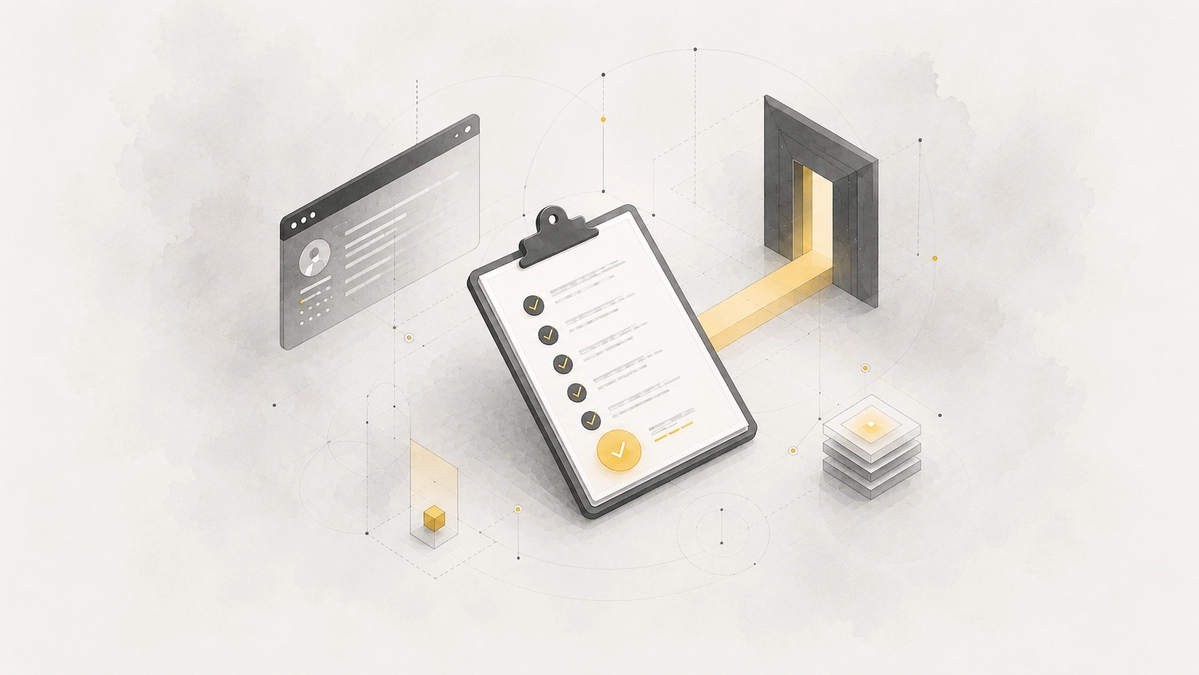

Most project problems do not start mid-project. They start on day one.
A client who is unclear on what they need to provide, unsure who to contact, and waiting for answers that should have been settled before the kickoff call is a client who will send three emails a day asking for updates. That back-and-forth is not a communication problem. It is a systems problem, and it has a direct fix.
A structured onboarding checklist removes the guesswork from the first week. It tells the client exactly what to expect, what to provide, and who handles what. That clarity does not just save time. It sets the tone for the entire project.
Why the First Week Matters More Than You Think
The data on onboarding is clear. Clients with a smooth onboarding experience are 53.5% less likely to churn [1]. The top quarter of B2B companies achieve a net revenue retention rate above 120% when onboarding is prioritised [1]. Every 5% gain in retention can yield up to 95% more profit [1].
Those numbers reflect something most service businesses underestimate: the first week is not just an administrative phase. It is where the client forms their opinion of how organised, reliable, and capable you are. A chaotic first week creates doubt that is very hard to reverse. A structured first week builds confidence that carries through every difficult conversation that follows.
74% of clients will redirect to competitors if onboarding feels complex or confusing [2]. That decision often happens before the real work has even started.
The Problem With Most Onboarding Processes
Most service businesses treat onboarding as something that happens after the contract is signed, a loose collection of emails, a kickoff call, and a shared folder link. No structure. No documented workflow. No consistent experience from one client to the next.
The result is predictable. Information arrives in pieces. The team asks the client for the same details three different ways across two weeks. The client, who hired you specifically because they do not have time to manage this themselves, ends up spending more time on admin than they expected [1].
Jumping into a project without all the necessary details is like building a house without a blueprint. A structured data collection phase eliminates guesswork and ensures the solution you deliver matches what the client actually needs [3]. That alignment does not happen by accident. It requires a deliberate system built before the first client walks through the door.
Step One: Collect Everything Upfront With a Single Questionnaire
The single highest-impact change most service businesses can make is sending a structured onboarding questionnaire before the kickoff call, not during it [4].
The questionnaire captures everything you need to start work without follow-up: contact details, decision-makers, communication preferences, project goals, existing assets, login credentials, and any constraints on timeline or budget. When a client completes this before the first call, the kickoff meeting shifts from information gathering to strategy and relationship building [4].
Design the questionnaire to feel purposeful, not bureaucratic. Frame each question around the client's benefit: "This helps us configure your setup correctly from day one" carries more weight than "Please fill this in." Address the time concern directly. A client who understands that ten minutes of their time now saves hours of back-and-forth later will complete the form [4].
Send the questionnaire only after payment and a signed agreement. Sending too much too soon, before the client is committed, creates confusion and risks losing momentum before the project starts [4].
Step Two: Send a Welcome Package Within 24 Hours of Signing
Once the agreement is signed, the clock starts. If the client does not hear from you within 24 hours, their confidence begins to drop [1].
A welcome package does not need to be elaborate. It needs to answer five questions the client is already asking: who is my main contact, what happens next, where do I find project files, what do you need from me, and when will I hear from you again [5].
The package should include a named point of contact with their direct details, a brief overview of the next 30 days, access credentials to the project portal or shared folder, and a short getting-started guide telling the client exactly what to send and by when [2].
The goal is to give the client one place to find everything [1]. Every separate email thread, every different WhatsApp message, every file shared through a different channel is another opportunity for something to get lost. Centralising everything in a single portal or shared folder from day one removes that friction permanently.
Step Three: Run a Structured Kickoff Call With a Sent-Ahead Agenda
The kickoff call is the most important single event in the onboarding process [2]. It sets the strategy, confirms expectations, and establishes the relationship. A poorly run kickoff undoes the goodwill created by even the best welcome package.
Send a structured agenda at least 24 hours before the call [2]. This gives the client time to prepare, signals that you respect their time, and prevents the meeting from drifting into a rambling discussion.
The agenda should cover introductions with clear roles, a review of project goals expressed in specific and measurable terms, a walkthrough of the timeline with key milestones, confirmation of communication preferences and response time expectations, and an explicit list of what the client needs to provide and by when [2].
The client's goals need to be documented in numbers where possible. "Increase organic traffic by 40% within six months" is a goal. "Improve the website" is not. Specific goals remove ambiguity and give both sides a shared definition of success [2].
Agree on communication frequency during this call, not after. Decide how often updates go out, through which channel, and what a "no-update update" looks like during quiet phases. Clients who know a check-in is coming on Friday do not send a status request on Thursday [1].
Step Four: Build a Visual Timeline With Named Milestones
After the kickoff, the client needs to see the whole picture. A visual timeline converts the project from an abstract commitment into a concrete sequence of events. Clients who can see when each phase ends and what follows feel less need to ask where things stand [3].
The timeline should include the key milestones, the date each is expected, what the client needs to provide ahead of each milestone, and the review or approval step that follows. Each milestone should have a named owner, either on your side or the client's, so there is no ambiguity about who is responsible for what moving forward [2].
Milestone-based workflows let both sides track progress without a meeting. Clients report realising value 40% faster when structured milestone sequences are in place [6]. The timeline becomes the default answer to "where are we?" without requiring a call to explain it.
Step Five: Preemptively Answer the Questions They Have Not Asked Yet
Every service business receives the same ten questions from new clients in the first two weeks. What is the best way to share files? How do I request a change? What happens if I miss a deadline? Who do I contact if I have a concern?
Writing the answers to these questions into an FAQ document and including it in the welcome package eliminates most of those inbound messages before they happen [5]. A well-built FAQ feels like preparation. It signals that you have done this before and anticipated what the client needs to know.
Preemptively addressing common concerns reduces inbound communication volume and demonstrates thoroughness without requiring the client to ask [5]. That combination of fewer questions from the client, more confidence in your team, is the practical definition of a smooth first week.
Step Six: Automate the Repetitive Scheduling and Reminders
Back-and-forth over meeting times is one of the most wasteful communication patterns in client work. A scheduling link sent in the welcome package removes it entirely [7]. The client books a time that works for them. The confirmation and reminder go out automatically. No one sends three emails to agree on 10 AM Tuesday.
Automated reminders also address the most common cause of onboarding delays: the client has not completed a task on time. A reminder sent 48 hours before a deadline, and again on the day, is far less awkward than a manual follow-up email asking why something has not arrived [7].
Automation works best on the administrative and repetitive parts of onboarding. Scheduling, reminders, document requests, and access credentials can all run automatically. The human involvement stays where it belongs, in strategy, relationship building, and decisions that require judgment [2].
The 90-Day Mark: When Onboarding Officially Ends
Onboarding is not just the first week. The formal phase runs through the first 90 days, and the transition out of it should not be abrupt.
Schedule 30, 60, and 90-day review calls during the kickoff meeting so they are already on the calendar [2]. These calls are strategic checkpoints that confirm progress against the goals agreed at the start, identify any misalignment before it becomes a problem, and signal to the client that the relationship is active and managed.
At the 90-day mark, the onboarding period closes and the ongoing engagement begins. Clients who reach that point feeling informed, valued, and aligned are the ones who renew, refer, and expand their work with you. Clients who reach it feeling like they had to manage the process themselves do not [2].
The checklist is the starting point. The system that runs it is what creates the outcome.
References
- HubSpot — Perfect Your Customer Onboarding With Our Expert Tips: https://blog.hubspot.com/service/client-onboarding-best-practices
- ALM Corp — Client Onboarding Checklist for Digital Agencies: The Complete 17-Step Framework: https://almcorp.com/blog/client-onboarding-checklist-digital-agencies/
- Widgetly — 10 Client Onboarding Best Practices to Implement in 2025: https://www.widgetly.co/blog/client-onboarding-best-practices
- AgencyAnalytics — New Client Onboarding Questionnaire: 37 Critical Questions: https://agencyanalytics.com/blog/client-onboarding-questionnaire
- Superdocu — Top Client Onboarding Best Practices for 2025 Success: https://www.superdocu.com/en/blog/client-onboarding-best-practices/
- Unkoa — 10 Client Onboarding Best Practices for B2B Agencies in 2025: https://www.unkoa.com/client-onboarding-best-practices/
- Statisfy — Top Client Onboarding Best Practices for 2025 Success: https://www.statisfy.com/resources/client-onboarding-best-practices
Comments
Be the first to comment.
Related reads

When Not to Automate: Understanding AI Automation Limitations
Automating a broken process only accelerates failure. Before implementing AI, it’s crucial to stabilize operations, define accountability, and assess risks.
Why Choosing SSG Over SSR in Next.js Can Boost Website Performance
Deciding between SSR and SSG for your Next.js project? This article explains why SSG is the superior choice for performance, speed, and SEO, especially for dynamic content.