
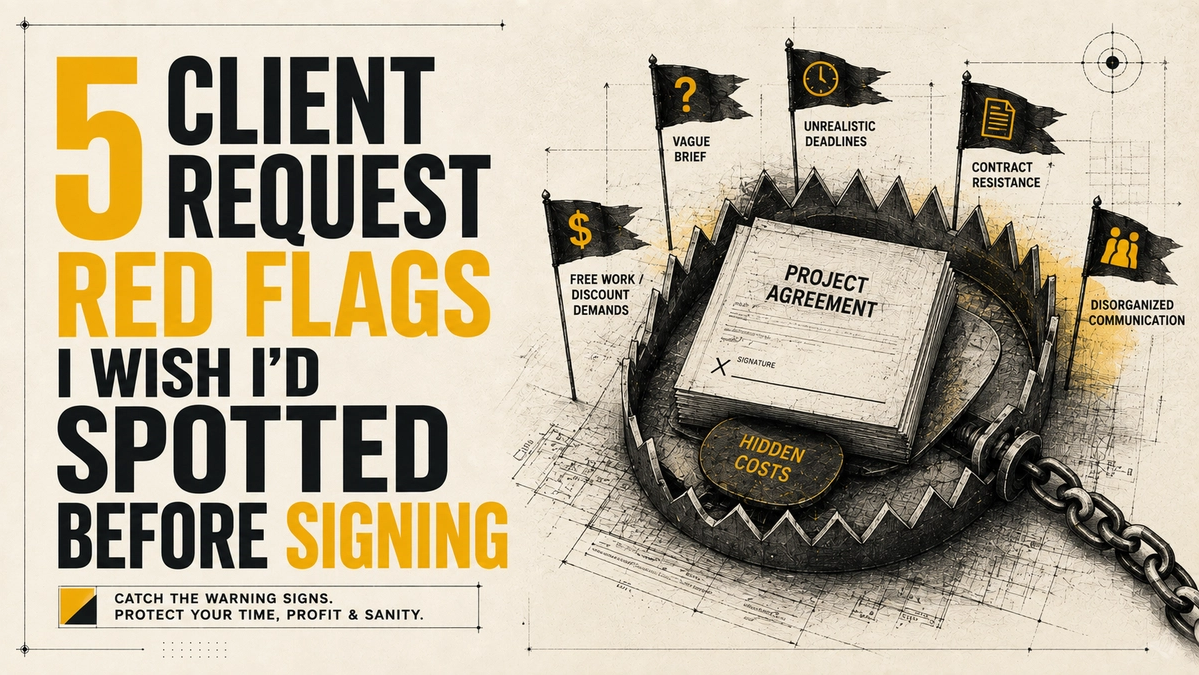
5 client request red flags I wish I'd spotted before signing

Identifying client red flags early protects your agency margins, stops unpaid scope creep, and keeps every freelance web project profitable from day one.
Most freelancers and small agency owners lose money because they miss clear client red flags in the first messages. Agencies lose between one thousand and five thousand dollars every month to unbilled work, according to a 2025 survey of more than two hundred seventy firms [1]. Freelancers report doing unpaid extras on sixty-seven percent of projects [10]. These patterns start in the initial request. Spotting client red flags early stops the drain and keeps your rates intact.
1. Vague Briefs Create Endless Unpaid Revisions
Vague project details almost always expand into unpaid work. Clients who describe a website rebuild or content series without listing pages, word counts, or revision limits force you to guess. That guess becomes free labor later. Scope creep affects fifty-seven percent of agencies, costing between one thousand and five thousand dollars every month, and only one percent recover payment for every extra hour [5]. One freelance writer accepted a five thousand dollar script package after the client sent a loose brief. The project ballooned into strategy sessions and endless drafts until she walked away [4]. A structured intake process, a real questionnaire instead of an open-ended "tell me what you need," is what actually forces this kind of ambiguity into the open before you quote rather than after. Clear requests include exact deliverables and limits. Anything less signals future disputes over what you promised.
2. Free Work Requests Signal Low Value
Clients who ask for free samples or steep discounts before any agreement show they undervalue the work. Spec work or test projects extract ideas without payment. Twenty-three percent of freelancers have faced clients who collect free strategy and then vanish [7]. Rate haggling that starts before the scope is clear predicts constant pressure later. Professional buyers review portfolios and move forward at market rates. Lowball requests or free labor demands cut your effective hourly rate and train the client to expect more for less. Decline those openings, and better projects fill the space.
Modern Forms of Unpaid Auditions
Unpaid requests rarely arrive as blatant demands for free labor anymore. Prospects repackage test work into casual requests for quick strategy decks or preliminary concept sketches. For example, design strategist Sagar Vaishnav documented a startup that requested a quick creative deck to visualize an app redesign. The request required eight hours of unpaid work before the company ghosted the designer who accepted it [13].
3. Unrealistic Deadlines Destroy Profitability
Unrealistic deadlines paired with normal budgets create immediate overtime. Clients who need a full site live in two weeks or a campaign ready by next Monday rarely adjust the fee for the rush. The pressure forces cut corners or unpaid nights. Service providers report that sixty-six percent of clients demand more while paying less [2]. The combination destroys margins and leads to burnout. A realistic timeline matches the scope and includes buffer days. When the request ignores that reality, the project costs more than it pays.
4. Contract Resistance Opens the Door to Trouble
Resistance to a simple written contract removes your strongest protection. Clients who prefer handshake deals or delay signing leave room for changed terms after work starts. Late payments affect eighty-five percent of freelancers, and twenty-nine percent of invoices arrive past due [3]. Without a signed document, recovery becomes harder. Contracts set payment schedules, revision caps, and ownership rules. Refusal to sign is a client red flag that predicts payment disputes and scope arguments.
Comparing Early Intake Indicators
Evaluating initial messages requires structured criteria rather than gut feelings. Comparing common intake behaviors against healthy alternatives clarifies when to send a proposal and when to decline.
| Intake Category | Red Flag Indicator | Healthy Client Alternative |
|---|---|---|
| Scope Clarity | Vague goals without defined page counts or revisions | Clear deliverable list with written boundaries |
| Sample Requests | Demands free strategy decks or test designs | Reviews existing portfolio and hires through paid discovery |
| Timeline Expectations | Demands rush delivery at standard pricing | Respects realistic production schedules with buffer days |
| Contract Attitude | Prefers verbal agreements or delays signatures | Signs agreements and pays upfront deposits promptly |
Can Red Flag Clients Be Saved Through Risk Premiums?
Some agency owners argue that refusing every risky project limits revenue growth during slow months. They suggest charging a fifty percent risk premium or requiring strict milestone payments to offset early warning signs. That approach assumes difficult buyers respect financial boundaries once a project begins.
In practice, high-risk buyers rarely honor structural boundaries. Research from Consulting Success shows that clients who display early friction spend far more time disputing change orders and delaying feedback [14]. The extra administrative overhead erodes any added margin you charge upfront. Filtering out troubled requests early protects team capacity for high-value relationships.
Why Walking Away Beats Filling the Calendar
Some freelancers claim they cannot turn work away because the pipeline stays empty. That view treats every request as income even when the numbers prove otherwise. Agencies lose up to sixty thousand dollars a year to unbilled extras [5][8]. Taking a problematic project fills the calendar with low-value hours and blocks higher-paying ones. Stephanie Walden ignored early ambiguity and constant calendar interruptions on a five thousand dollar assignment. Six weeks of chaos later, she quit and recovered her time [4]. The short-term gap from saying no closes faster once bad clients stop consuming capacity. Quality work attracts better buyers who pay on time and respect boundaries.
The Broader Financial Impact of Early Screening
Turning down problematic leads prevents compounding industry losses. Data published by Jobbers reports that unpaid extra work accounts for billions of dollars in annual losses across the freelance economy [12]. Seventy-three percent of independent service providers also report experiencing client non-payment at least once during their careers [11].
FAQ
How early can client red flags appear?
They show up in the first email or call. Vague language, free work requests, or deadline pressure surface before any proposal leaves your desk. Address them then or walk away.
What is the biggest financial cost of ignoring these signs?
Scope creep alone costs freelancers thousands of dollars every year. Agencies lose between one thousand and five thousand dollars each month on unbilled tasks [5]. Late payments add more lost income [3].
Can a good contract fix a red flag client?
A strong contract helps but cannot fix a client who already resists clarity or fair rates. The best contracts still fail when the buyer never intended to follow them. Prevention beats repair.
Should I ever accept a project with one minor red flag?
One mild flag can be managed with extra written limits. Multiple flags, or any major resistance to contracts or rates, mean the risk outweighs the fee. Decline the project and move on.
How do I respond when a client pushes past my boundaries?
State the original agreement in writing and quote the extra fee for changes. If they refuse the added cost, stop the additional work. Consistent enforcement encourages better behavior from the clients you keep.
The freelancers who build lasting practices treat the first client message as a filter rather than an opportunity. Clear boundaries in those early exchanges free capacity for projects that pay fully and run smoothly. Future income depends on the requests you refuse today. Strict qualification standards support steady business growth and healthier client partnerships over time.
References
- Ignition — 2025 Agency Pricing and Cash Flow Report: https://www.ignitionapp.com/news/2025-agency-pricing-cashflow-report
- Wunderland Media — Clients Getting Harder to Work With: https://wunderlandmedia.com/clients-getting-harder-to-work-with-not-in-your-head
- Agiled — Late Payment Statistics 2026: https://agiled.app/statistics/late-payment-statistics
- Contently — Firing a Nightmare Client and Losing $5,000 Was the Best Decision: https://contently.net/2021/09/16/voices/firing-nightmare-client/
- DEV Community — 57 Percent of Agencies Lose $1K to $5K Monthly to Scope Creep: https://dev.to/valynx_saas/57-of-agencies-lose-1k-5k-monthly-to-scope-creep-heres-why-it-keeps-happening-39hf
- Brisk — 10 Client Red Flags Every Freelancer Should Know Before Signing: https://staybrisk.com/blog/10-client-red-flags-every-freelancer-should-know-before-signing
- Kreev — 12 Freelance Client Red Flags and How to Avoid Them: https://kreev.io/blog/freelance-client-red-flags/
- The Drum — Cash Flow Crunch: US Agencies Struggle to Grow as Late Payments and Scope Creep Bite: https://www.thedrum.com/news/cash-flow-crunch-us-agencies-struggle-grow-late-payments-and-scope-creep-bite
- Sengi — The Hidden Cost of Scope Creep: https://sengi.co/blog/scope-creep-cost-freelancers/
- Jobbers — Freelance Client Satisfaction Survey: https://www.jobbers.io/freelance-client-satisfaction-survey-what-2000-clients-hate-about-hiring/
- Freelancers Union data via Agiled and related reports: https://agiled.app/statistics/late-payment-statistics
- Jobbers — The Freelance Client Red Flags Database: https://www.jobbers.io/the-freelance-client-red-flags-database/
- Sagar Vaishnav — The 2026 Client Red Flags Every Freelancer Needs to Know (Before You Sign): https://sagarsvaishnav.medium.com/the-2026-client-red-flags-every-freelancer-needs-to-know-before-you-sign-a00af66f6f9d
- Consulting Success — 12 Consulting Client Red Flags You Should Avoid Working With: https://www.consultingsuccess.com/consulting-client-red-flag-list
Comments (1)
- Shubham1mo ago
Good Insights. Worth Reading.
Related reads

When Not to Automate: Understanding AI Automation Limitations
Automating a broken process only accelerates failure. Before implementing AI, it’s crucial to stabilize operations, define accountability, and assess risks.
Preparing Your Team for Web AI Design Shifts: Prioritizing User Experience
In the face of rapidly evolving AI and web design technologies, prioritize user experience over simply adopting the latest tools. Discover how to prepare your team for these essential shifts.