
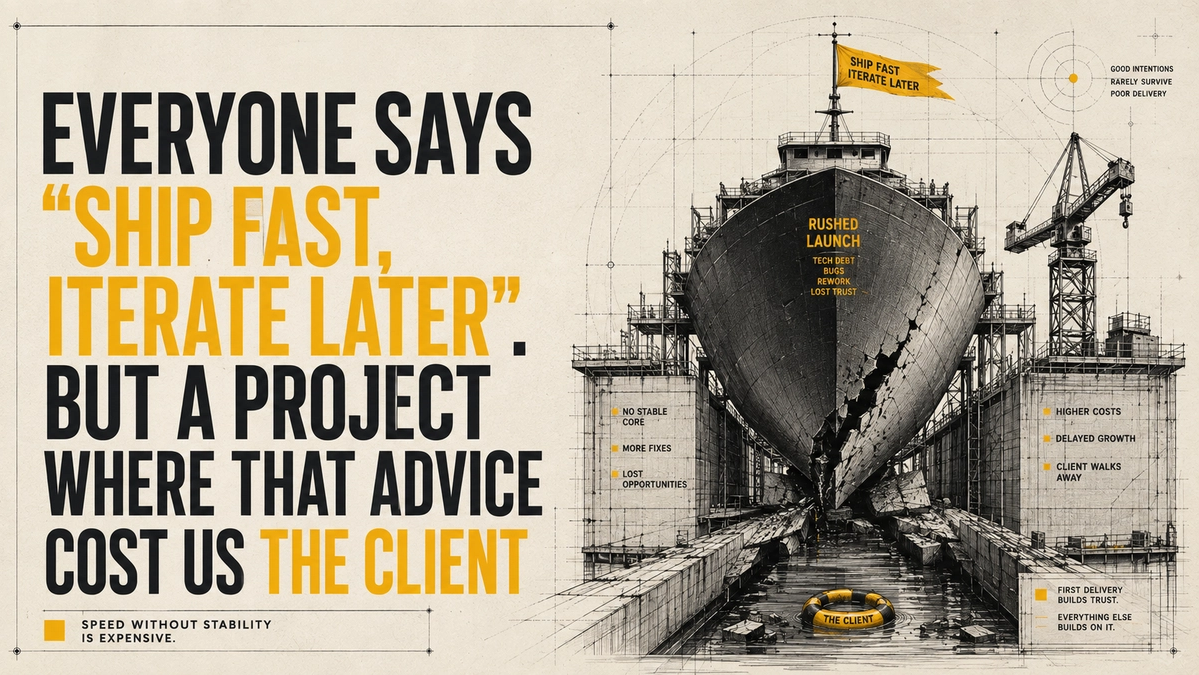
Everyone says "ship fast, iterate later". But a project where that advice cost us the client

The modern software landscape thrives on speed. Startup founders, agency leads, and enterprise product managers preach velocity above almost all else. The popular doctrine to ship fast, iterate later frequently gets misinterpreted as permission to bypass essential architecture entirely.
Moving quickly to gather user feedback is a sound strategy. The breakdown occurs when teams confuse rapid iteration with shipping fundamentally broken systems. Launching an unstable core does not accelerate learning. Instead, it buries engineering teams under immediate maintenance overhead, damages client trust, and creates exponential rework.
The True Cost of Unstable Software Velocity
When product leaders push features into production without establishing core stability, they accumulate structural technical debt. Recent engineering data reveals that unmanaged technical debt absorbs 21% to 40% of total IT budgets [1]. Rather than building new revenue-generating features, developers spend up to two days per week patching fragile codebases.
Failure rates across the software industry highlight the severity of poor operational foundations:
- Low Success Rates: According to long-term Standish Group CHAOS data, only 31% to 35% of software projects finish on time, on budget, and with their full intended scope [2].
- Severe Scope Creep: Project Management Institute (PMI) research indicates that 52% of active projects experience scope creep, driving an average budget overrun of 27% [3].
- Agency Revenue Erosion: Data compiled by DEV Community shows that 57% of software agencies lose between $1,000 and $5,000 each month because of unmanaged scope growth and structural rework [4].
- Budget Exhaustion: Project analysis from DesignRush reports that only 31% of client builds finish on budget without major architectural course corrections [5].
Key Takeaway: Speed is an asset only when built on reliable infrastructure. Shipping an MVP with known UX rough edges is smart validation. Shipping an MVP with corrupt database schemas or security vulnerabilities creates organizational debt.
Comparing MVP Approaches: Stable Core vs. Unstable Rapid Build
To understand why some software products scale smoothly while others require expensive rewrites, compare the two primary execution strategies.
| Execution Metric | Unstable Rapid Build | Stable Core Iterative MVP |
|---|---|---|
| Initial Time-to-Market | Extremely fast (1–4 weeks) | Moderate (4–8 weeks) |
| Early User Bug Reports | High (critical system crashes) | Low (minor UI/UX feedback) |
| Refactoring Overhead | 50%–70% of future sprint capacity | 10%–15% of future sprint capacity |
| Scope Control | Uncontrolled feature growth | Strict core-value boundaries |
| Long-Term Rescue Cost | $15,000–$50,000+ full rebuild [6] | Minimal incremental upgrades |
| Average Project Success | Highly vulnerable to early churn | High retention with a scalable foundation |
Case Study: AI Velocity Pods and the $18K Shipping Balance
Consider how engineering teams navigate the trade-offs between speed and stability in real-world environments.
The Freelancer MVP Rescue Nightmare
Agencies and startups routinely hire budget freelancers to ship minimum viable products at breakneck speed. As documented by Rocking Tech, many of these rapidly built MVPs require extensive codebase rescue work within six months [6]. The initial savings disappear when new developers must dismantle unmaintainable code to add basic payment pipelines or authentication.
The $18,000 Late Shipping Penalty vs. Scope Discipline
Perfectionism carries its own cost. Research from Haven AI illustrates that over-engineering an initial product release can delay market entry and reduce early revenue opportunities [7].
The middle ground lies in disciplined scope control. When Indie Hackers tracked AI velocity pods launching six micro-products over 90 days, the successful products were not those with the most features [8]. They defined strict functional boundaries, guaranteed data integrity and API stability, and deliberately omitted non-essential user settings.
Counterargument: Is Rapid Throwaway Code Ever Justified?
Proponents of Lean Startup methodology often argue that early code should be treated as disposable [9]. From this viewpoint, spending time on clean architecture before proving product-market fit wastes valuable capital. If a product fails to gain traction, the quality of its underlying code becomes irrelevant.
This argument holds true for simple landing page tests, clickable prototypes, or short-lived marketing campaigns. The logic breaks down once a product handles user data, financial transactions, or automated workflows.
When a throwaway product gains rapid user adoption, scaling an unstable foundation becomes far more expensive than building a clean core from the beginning. Agency statistics from Breeze indicate that architectural failures during growth periods account for a substantial share of early-stage customer churn [10].
How to Build a Stable Core Without Sacrificing Speed
Maintaining software momentum without accumulating technical debt requires clear operational guidelines.
- Decouple Core Logic from UI Polish: Build reliable backend APIs and data models first. Visual styling and UI polish can be iterated without risking system integrity.
- Set Non-Negotiable Core Criteria: Define exactly what belongs in the core. Security, database schema stability, and transaction flows should never be compromised.
- Establish Strict Scope Gates: Prevent mid-sprint feature additions. Managing client expectations and scope creep protects both budget and delivery timelines [11].
- Automate Core Testing Early: Write integration tests for critical user paths. Automated regression checks prevent new feature deployments from breaking existing infrastructure.
Frequently Asked Questions
What is the difference between technical debt and a minimum viable product?
An MVP is a functional product built with the minimum set of features required to validate core value with real users. Technical debt refers to structural compromises in code quality or architecture that require future refactoring.
How can product managers prevent scope creep during rapid development?
Product managers can limit scope creep by establishing strict feature gates, locking sprint commitments, and requiring clear user-value justification before adding new requirements to active builds.
Why do freelancer-built MVPs frequently need total rebuilds?
Rapidly built freelancer projects often prioritize short-term visual deliverables over long-term maintainability. This results in hardcoded values, missing documentation, tight coupling, and security gaps that make future feature additions difficult without extensive refactoring.
How much technical debt is acceptable in an early-stage product?
Acceptable technical debt includes deferred UI animations, manual administrative tasks, or non-automated internal analytics. Unacceptable technical debt includes unstable database relationships, broken authentication logic, and unencrypted sensitive data.
References
- Deloitte Global Technology Leadership Study via Software Improvement Group: https://www.softwareimprovementgroup.com/blog/cost-of-technical-debt/
- Standish Group CHAOS Report via OpenCommons: https://opencommons.org/CHAOS_Report_on_IT_Project_Outcomes
- Project Management Institute (PMI) Thought Leadership & Pulse Reports: https://www.pmi.org/learning/thought-leadership/pulse
- DEV Community — 57 Percent of Agencies Lose $1K to $5K Monthly: https://dev.to/valynx_saas/57-of-agencies-lose-1k-5k-monthly-to-scope-creep-heres-why-it-keeps-happening-39hf
- DesignRush — Project Success Rate and Scope Creep Analysis: https://news.designrush.com/project-success-rate-discovery-phase-scope-creep
- Rocking Tech — The Real Cost of a Freelancer-Built MVP: https://rockingtech.co.uk/blog/the-real-cost-of-a-freelancer-built-mvp-that-needs-rescuing
- Haven AI — The $18K Cost of Shipping Perfect Code Late: https://havenai.io/blog/the-18k-cost-of-shipping-perfect-code-late/
- Indie Hackers — We Shipped 6 Products in 90 Days: https://www.indiehackers.com/post/we-shipped-6-products-in-90-days-using-ai-velocity-pods-heres-what-we-learned-about-scope-control-8ff3d5e882
- Agile Alliance — Build, Measure, Learn in Lean Startup: https://agilealliance.org/build-measure-learn-lean-startup/
- Breeze — Agency Project Management Statistics: https://www.breeze.pm/articles/agency-project-management-statistics
- Wunderland Media — Managing Client Expectations and Scope Creep: https://wunderlandmedia.com/clients-getting-harder-to-work-with-not-in-your-head
- Agiled — Project Management Statistics: https://agiled.app/statistics/project-management-statistics
- TechDebtCost — Technical Debt Impact Statistics: https://techdebtcost.com/stats
Comments (1)
- Shubham Gujarathi1mo ago
Nice Insights, Worth Reading.
Related reads

When Not to Automate: Understanding AI Automation Limitations
Automating a broken process only accelerates failure. Before implementing AI, it’s crucial to stabilize operations, define accountability, and assess risks.

Preparing Your Team for Web AI Design Shifts: Prioritizing User Experience
In the face of rapidly evolving AI and web design technologies, prioritize user experience over simply adopting the latest tools. Discover how to prepare your team for these essential shifts.