
How to price a web project without undercharging (a framework for small agencies)

Meta description: Learn how to price a web project with a proven framework that covers real delivery costs, protects profit margins, and supports long-term agency growth.
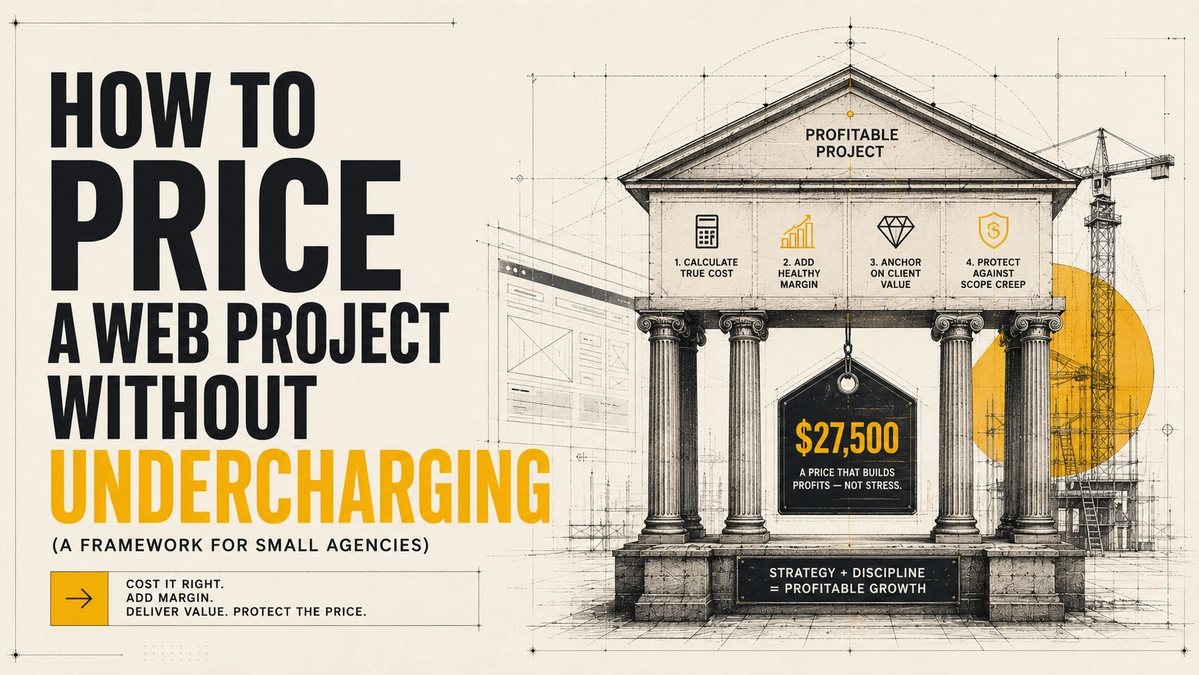
Most small agencies undercharge on web projects. They look at competitor quotes, guess at hours, and hope the number feels acceptable to the client. The result is thin margins, unpaid overtime, and teams that stay small. A structured framework changes that. Calculate true delivery cost, add a healthy margin, check the value the client receives, and protect against scope changes. Agencies that follow these steps stop leaving money on the table and start treating each project as a profitable unit of work.
Start With Real Delivery Cost, Not Guesswork
Break the project into phases and estimate hours honestly. A typical five-to-ten-page business site often requires discovery and strategy, wireframes and visual design, development, content entry, quality assurance, and launch support. One detailed breakdown puts total effort near 123 hours when project management is included at 15 percent [1]. Multiply those hours by a blended internal rate that covers salaries, tools, overhead, and non-billable time. At 100 dollars per hour, the cost lands at 12,300 dollars. At 125 dollars per hour, the cost rises to 15,375 dollars [1]. This number is the floor. Anything below it means the agency subsidizes the client. Recent US data places the median project size for a five-page website at about 3,850 dollars, yet many small agencies still quote far lower and absorb the difference in unpaid hours [2].
Add Margin That Supports Growth
Once cost is clear, set a delivery margin target. A 50 to 55 percent margin after delivery cost produces a sustainable price. Using the 12,300 dollar cost example, the formula, cost divided by one minus margin, yields roughly 27,300 dollars at a 55 percent margin [1]. Round to a clean figure such as 27,500 dollars. This margin covers taxes, slow periods, marketing, and future investment. Agencies that skip this step and price near cost stay trapped in low revenue bands. Survey data shows that designers and small shops earning under 25,000 dollars a year dominate the lower project ranges, while those charging 2,500 dollars and above per project cluster in higher revenue groups [3]. Higher project prices correlate with higher annual revenue.
Check Client Value Before Finalizing the Number
Cost-plus margin sets a floor. Value sets the ceiling. Ask what the finished site will produce for the client, more leads, higher conversion, reduced support costs, or stronger brand perception. If a redesign lifts monthly revenue by tens of thousands of dollars, a fee that captures a small share of that gain is fair and easier to justify. One agency that moved from hourly averages of 2,000 to 5,000 dollars to value-aligned packages saw average website fees rise to around 10,000 dollars while attracting larger clients [4]. Another example anchored a 6,000 dollar non-profit site against projected multi-year enrollment gains and closed the deal with full payment upfront [5]. Clients accept higher numbers when the conversation centers on their outcomes rather than your hours.
Protect the Price Against Scope Creep
Fixed prices fail when scope is vague. Add a 15 percent buffer for uncertainty when the client or requirements feel fluid, then round again [1]. Require paid discovery for complex work. Only 15 percent of designers charge for discovery, yet those who do are twice as likely to land projects above 5,000 dollars [3]. A structured onboarding process, unified questionnaires, a clear welcome package, and a visual timeline, is what makes that paid discovery phase actually catch scope problems instead of just adding a billed step that still misses the same gaps. Write a clear scope document, define revision limits, and set a change-order process. Fixed-price projects often overrun by 20 to 40 percent or more, dropping the effective rate well below the intended number [6]. Payment milestones of 30 to 50 percent upfront and staged releases keep cash flow healthy and reduce the chance of final payment disputes.
Market Reality and Tiered Packages
Small boutique agencies typically charge 5,000 to 25,000 dollars for a solid small-business site, with most falling in the 6,000 to 15,000 dollar range [7]. Freelancers sit lower at 1,500 to 8,000 dollars. Mid-size shops start higher. Present three packages so the middle option becomes the natural choice. Starter packages catch price-sensitive buyers. Professional packages deliver the core value. Premium packages include extras that raise the average deal size. Agencies that offer only one price force every conversation into a discount discussion. Tiered options shift the focus to which level of result the client needs.
| Tier Level | Target Client | Typical Scope | Pricing Strategy |
|---|---|---|---|
| Starter | Price-sensitive clients | Essential 5-page setup, template customization | Covers floor delivery cost with standard margin |
| Professional | Core business clients | Custom visual design, full CMS build, basic SEO | Captures value aligned with client conversion gains |
| Premium | High-growth brands | Advanced integrations, custom animations, copy support | Maximizes deal size through high-impact deliverables |
Addressing the Hourly Transparency Argument
Some clients push for hourly billing because they believe tracked hours guarantee pricing transparency. They assume hourly rates prevent overpaying if a project finishes early. That view overlooks how hourly pricing penalizes fast delivery and rewards slow work. Data compiled by SoloFinanceHub indicates that agencies using fixed value pricing report higher client satisfaction than those billing by the hour [8]. Fixed tiers provide budget predictability for clients while rewarding internal team efficiency.
Industry Benchmarks Across Agency Sizes
An analysis of project proposals by Folyo found that many agencies adjust quotes based on client revenue rather than project length [9]. Market rates shift depending on agency size, team structure, and target audience. Industry benchmarks recorded by Web Cost Estimator show how delivery costs align with market pricing tiers [10].
| Agency Tier | Average Project Price | Typical Delivery Cost | Target Margin |
|---|---|---|---|
| Freelancer | $1,500 to $8,000 | $800 to $3,500 | 45% to 50% |
| Boutique Agency | $6,000 to $25,000 | $2,700 to $11,000 | 50% to 55% |
| Mid-Size Agency | $25,000 to $75,000 | $10,000 to $30,000 | 55% to 60% |
Understanding these industry ranges helps team leads position their proposals accurately. Agencies pricing below their tier average risk signaling lower quality to high-value buyers.
FAQ
What is a realistic starting price for a small business website?
Most professional small-agency builds land between 5,000 and 15,000 dollars for a five-to-ten-page site with custom design and a basic CMS. Quotes below 3,000 dollars usually signal missing process, unpaid discovery, or thin margins [2][7].
Should small agencies charge hourly or fixed?
Fixed or value-based pricing works better for defined web projects. Hourly pricing caps income and rewards slow delivery. Use hourly only for truly open-ended support or discovery phases [1][3].
How much margin should a web project carry?
Target 50 to 55 percent after true delivery cost. Lower margins leave no room for overhead, marketing, or downtime. Higher margins become possible once value conversations replace pure cost calculations [1].
Does paid discovery really help?
Yes. Agencies and designers who charge for discovery land higher-value projects more often and reduce the risk of under-scoped work. It signals seriousness and filters clients who treat scoping as free consulting [3].
What if the client pushes back on price?
Return to the value discussion. Show the expected business outcome and the risk the agency carries. Offer a reduced-scope package rather than a pure discount. Clients who only care about the lowest price rarely become profitable long-term relationships.
Agencies that price from cost, protect margin, and speak in client outcomes stop undercharging. The framework turns every proposal into a clear business decision instead of a hopeful guess. Consistent application raises average project value, improves cash flow, and creates room to grow beyond the next invoice. Sustainable pricing shifts agency culture toward long-term profitability and client success.
References
- Corcava — How to Price Web Design Projects (Without Losing Money): https://corcava.com/blog/how-to-price-web-design-projects
- Lindo.ai — State of Web Design Agencies in the US — 2026: https://lindo.ai/reports/web-design-agencies-united-states
- Web Designer Academy — What Web Designers Actually Charge: 2025 Pricing Report: https://webdesigneracademy.com/state-of-web-designer-pricing-2025/
- Millo — How Switching to Value-Based Pricing Transformed Our Small Agency: https://millo.co/how-switching-to-value-based-pricing-transformed-our-small-agency-and-answers-to-questions
- Matt Olpinski — How I Sold a $6,000 Website to a Non-Profit Using Value-Based Pricing: https://mattolpinski.com/articles/the-6k-non-profit-website/
- Apropo — The Fixed-Price Project That Almost Ruined Our Agency: https://apropo.io/blog/fixed-price-project-almost-ruined-our-agency/
- WP Super Help — Web Design Pricing: How Much to Charge (Agency Guide): https://wpsuperhelp.com/web-design-pricing/
- SoloFinanceHub — Value-Based Pricing for Freelancers Guide: https://solofinancehub.com/blog/value-based-pricing-freelancers
- Folyo — The State of Web Design Agency Pricing in 2025: Insights from 500 RFPs: https://www.folyo.me/blog/web-design-agency-pricing-2026
- Web Cost Estimator — Web Design Agency Cost in 2026: https://webcostestimator.com/guides/web-design-agency-cost
Comments
Be the first to comment.
Related reads

When Not to Automate: Understanding AI Automation Limitations
Automating a broken process only accelerates failure. Before implementing AI, it’s crucial to stabilize operations, define accountability, and assess risks.
Preparing Your Team for Web AI Design Shifts: Prioritizing User Experience
In the face of rapidly evolving AI and web design technologies, prioritize user experience over simply adopting the latest tools. Discover how to prepare your team for these essential shifts.