
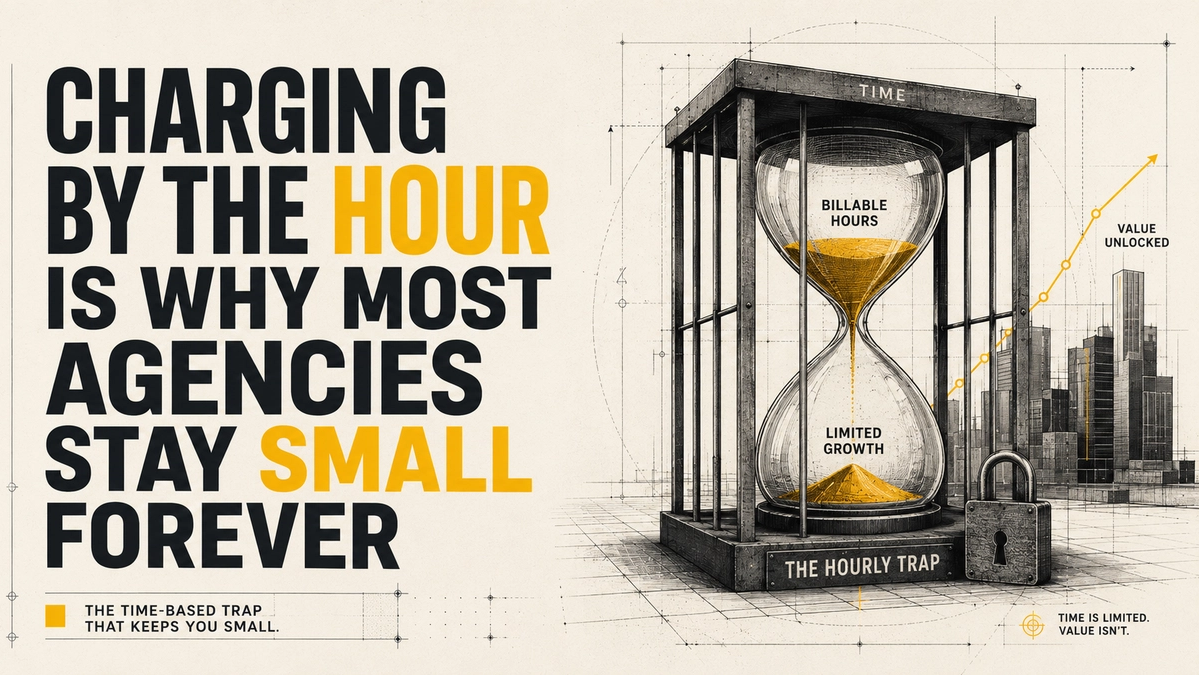
Charging by the hour is why most agencies stay small forever

Hourly billing looks clean on paper. Track time, multiply by the rate, and send the invoice. That simplicity traps most agencies under a hard ceiling. Revenue can never outrun the number of billable hours available each week. Efficiency gains shrink the invoice instead of raising profit. Clients question every line item. The model rewards slow work and punishes speed. Agencies that stay on hourly billing stay small because the structure itself blocks scale.
The Hard Ceiling Built Into Every Timesheet
A strategist billing at 150 dollars per hour and logging 30 billable hours per week tops out near 18,000 dollars in monthly revenue when fully booked [2]. The same person under value-based retainers can generate 25,000 dollars or more from the same hours by pricing the business impact instead of the clock [2]. That gap compounds across a team. Agencies lose 10 to 20 percent of potential revenue to unbilled time and write-offs under pure hourly systems [3]. Utilization never reaches 100 percent, so the theoretical maximum remains theoretical. The calendar becomes the growth limit. Hiring more people only multiplies the same constrained model. Revenue rises in lockstep with headcount while margins stay flat or shrink under the weight of more timesheets and more disputes. Rate-based pricing remains the predominant form of compensation across much of the industry, yet the data shows its limits clearly [1].
Recent benchmarks place average net margins for hourly-billed agencies near 13 percent. Value-based firms reach about 18 percent [12]. That five-point difference compounds across years and team size. An agency running pure hourly work must keep adding people to grow top-line revenue. Each new hire brings more non-billable overhead and more timesheet disputes. The structure itself keeps the firm locked into a linear growth path.
How Hourly Billing Punishes Getting Better
Every improvement in process, tooling, or skill reduces the hours needed for the same result. Under hourly billing, that reduction cuts revenue. A team that finishes a campaign in half the time earns half the fee. The incentive points the wrong way. Agencies that switch report revenue per client rising 30 to 300 percent while client churn falls [2]. One SaaS growth agency moved from hourly to a performance-linked model and lifted average monthly revenue from 130,000 dollars to 340,000 dollars in 18 months, with higher retention and 60 percent better team productivity [4]. Another firm saw project values climb 578 percent over four years after dropping the hour as the unit of sale [5]. Speed and expertise become assets instead of liabilities. The agency keeps the gain from its own improvements instead of handing it to the client as a discount. Pure hourly rates still account for a large share of agency work, but results-oriented models continue to gain ground [10].
AI tools accelerate this pressure. Tasks that once required many hours now finish faster. Clients notice the shorter timelines and expect lower invoices under hourly rules. Agencies that price the outcome keep the efficiency gain. Those that price the clock lose it.
The Counterargument That Hourly Feels Safer
Many owners defend hourly billing because it feels transparent and protects against scope creep. The client pays only for time used, and undefined work stays flexible [6]. That protection is real for pure discovery or experimental projects. Yet the same transparency creates constant friction. Clients watch the clock, question estimates, and push for discounts on rates. Forecasting becomes unreliable because revenue swings with utilization. Twenty percent of agencies still rely on hourly as their main model even while reporting cash flow problems and stalled growth [7]. The safety of the timesheet is expensive. It trades long-term scale for short-term predictability that never arrives. Agencies that keep hourly for overflow while moving core work to fixed or value pricing capture the flexibility without the ceiling. Time-and-materials remains common, yet the shift toward retainers and fixed fees is measurable [11].
The transparency argument holds for early-stage or highly variable work. Once scope becomes repeatable, the same transparency turns into a tax on speed. Clients begin to treat every hour as negotiable. The agency spends more time defending timesheets than improving results. Hybrid approaches solve the tension without keeping the full ceiling.
Margins and Valuation Tell the Same Story
Value-based pricing firms reach about 18 percent net margins, while hourly-billed agencies sit near 13 percent [8]. Retainers and fixed models improve cash flow predictability and raise acquisition multiples. Agencies with heavy retainer revenue trade at 1.2 to 2.0 times revenue, compared with 0.5 to 0.9 times for project-heavy shops [9]. Buyers pay more for predictable income streams that do not depend on filling every hour. Fifty-five percent of agencies still use hourly for at least some work, yet the trend moves toward retainers and packages [3]. The data shows the path out of small-scale operations runs through pricing that decouples income from the clock. Agencies shifting models report margin gains of 15 to 30 percent in multiple benchmarks [3].
| Pricing Model | Typical Net Margin | Revenue Predictability | Growth Constraint |
|---|---|---|---|
| Hourly | ~13 percent | Low | Calendar and headcount |
| Fixed project | ~14 percent | Medium | Estimation accuracy |
| Retainer | ~16 percent | High | Scope definition |
| Value-based | ~18 percent | Variable to high | Ability to quantify impact |
The table makes the structural difference clear. Higher margins and better multiples follow models that price outcomes. Hourly keeps both lower because revenue cannot outrun available hours.
Practical Path Out of the Hourly Trap
Start with new clients. Quote fixed or value-based fees on defined outcomes while keeping existing hourly accounts stable. Measure the client's expected gain during discovery and anchor the fee to a share of that gain. Packaging repeatable services into fixed-price, defined-scope offers turns the deliverable, not the hours, into the product, the same shift this section is describing. Track the effective hourly rate after the fact to confirm the model improves margins. Agencies that complete this shift free capacity, raise average deal size, and stop trading time for money. The structure itself begins to support growth instead of limiting it. One machine manufacturing client saw a 318 percent rise in qualified leads after moving away from pure hourly collaboration [10].
A Melbourne design agency that specialized and moved to impact-based pricing doubled revenue in two years. Margins rose from 11 percent to 20 percent, and average project value climbed 65 percent [13]. The same pattern appears across multiple case studies. New clients accept the new model more readily than existing ones. Gradual migration protects cash flow while the team learns to quantify and sell outcomes.
FAQ
Why does hourly billing limit agency size?
Revenue stays tied to available hours. Even at high utilization, the calendar sets a hard maximum. Efficiency reduces billable time and, therefore, income. Scaling requires more people under the same constraint rather than higher leverage from the same team [2][3].
Is hourly billing ever the right choice?
It works for pure advisory, truly undefined scope, or short experimental work with trusted clients. For ongoing production or results-driven campaigns, it creates misaligned incentives and caps growth [6].
How much can revenue rise after switching models?
Agencies report 30 to 300 percent higher revenue per client and clearer margins once price reflects impact rather than time [2]. Specific cases show monthly revenue more than doubling within 18 months while team size stays stable [4].
What happens to client relationships under value pricing?
Clients focus on outcomes instead of line-item hours. Trust rises when the fee is tied to results they care about. Churn often falls because both sides share the same goal [2][4].
How do agencies handle scope changes without hourly rates?
Define the core outcome and price it. Treat material additions as new scoped work with a separate fee. Clear discovery and written change processes replace the open-ended timesheet [5].
Do higher margins from value pricing hold after AI tools lower delivery time?
Yes. Value pricing captures the efficiency gain instead of passing it to the client as a lower invoice. Hourly rates shrink as delivery speeds rise [12].
The agencies that stay small keep selling hours. The ones that grow sell results, packages, and predictable value. The difference is structural, not motivational. Pricing that rewards efficiency and captures impact removes the ceiling that hourly billing installs by design.
References
- 4As — 4As 2025 Billing Rate Benchmark Survey: Agency Hourly Billing Rates: https://www.aaaa.org/resource/4as-2025-billing-rate-benchmark-survey-agency-hourly-billing-rates/
- Bullenweg — Stop Charging Hourly: The Case for Value-Based Pricing: https://bullenweg.com/stop-charging-hourly-the-case-for-value-based-pricing/
- AgencyPro — Agency Pricing: 60+ Statistics and Benchmarks: https://agencypro.app/blog/agency-pricing-statistics
- Growth Rocket — The End of Billable Hours: Value-Based Agency Pricing: https://www.growth-rocket.com/blog/building-an-ai-native-agency-from-scratch/
- Gatilab — Value-Based Pricing: Framework, Implementation, and Client Negotiation: https://gatilab.com/the-complete-guide-to-value-based-pricing/
- Nymble — Agency Pricing Models: Hourly, Fixed, Retainer, and Value-Based Compared: https://nymble.io/blog/agency-pricing-models-guide/
- B&T — 93% Of Agencies Are Raising Prices — But Why Are So Many Still Leaking Profit?: https://www.bandt.com.au/93-of-agencies-are-raising-prices-but-why-are-so-many-still-leaking-profit/
- Agiled — Agency Pricing Statistics (2026): Hourly Rates & Pricing Models: https://agiled.app/statistics/agency-pricing-statistics
- Northstar Financial Advisory — Retainer vs. Project Pricing: Financial Impact on Your Agency: https://nstarfinance.com/resources/retainer-vs-project-pricing-agency
- Brixon Group — Brixon Group's 4 Reasons for Eliminating Hourly Rates: https://brixongroup.com/en/brixon-groups-4-reasons-for-eliminating-hourly-rates/
- Function Point — Pricing Strategies That Work: How Agencies Are Balancing Growth & Stability: https://functionpoint.com/blog/pricing-strategies-that-work-how-agencies-are-balancing-growth-stability
- Agiled / Promethean Research — Agency Pricing Statistics (2026): https://agiled.app/statistics/agency-pricing-statistics
- Memtime — Hourly Billing vs Value-Based Pricing: Opportunities, Risks & Realities: https://www.memtime.com/blog/hourly-billing-vs-value-based-pricing-opportunities-risks-realities
Tags
Comments
Be the first to comment.
Related reads

When Not to Automate: Understanding AI Automation Limitations
Automating a broken process only accelerates failure. Before implementing AI, it’s crucial to stabilize operations, define accountability, and assess risks.
Preparing Your Team for Web AI Design Shifts: Prioritizing User Experience
In the face of rapidly evolving AI and web design technologies, prioritize user experience over simply adopting the latest tools. Discover how to prepare your team for these essential shifts.