
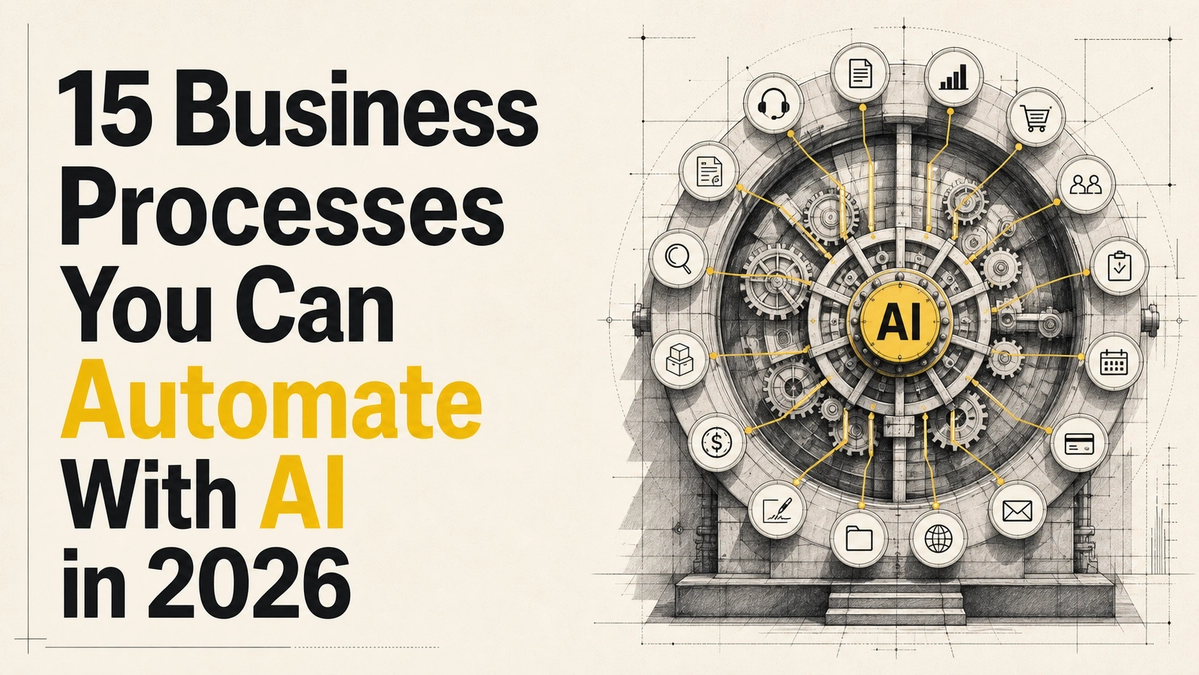

Companies worldwide now face a pressing question: how to keep productivity high while routine tasks multiply and eat into precious work hours. Business process automation examples powered by AI aren't just a trend—they are a clear route to sharper efficiency and tangible workflow automation ROI. Small businesses from India to Europe are using AI to take over repetitive tasks and let people focus on creative, growth-driving work. If you want lasting results and a team that thrives, it's time to see how smart workflow solutions—from n8n workflow examples to AI automation—can redefine your daily operations.
The Efficiency Boost: Why AI-Powered Automation Matters
Manual tasks slow organizations down. Staff spend hours on repetitive work like entering data, updating spreadsheets, or responding to basic customer queries. By 2026, automation will take over 60% of routine tasks in most businesses, driving major productivity gains [1]. With AI automation, companies slash wasted time and put their people onto high-value work. Teams can finally step off the hamster wheel of endless paperwork and focus on tasks that require judgment and expertise. This shift dramatically improves not just daily output, but also long-term morale. Whether you examine business process automation examples from regional banks or AI automation for small business India, the results speak for themselves. Moving slow for the sake of tradition is no longer an option—AI-powered automation is the new standard for operational excellence.
Real-World Examples of Business Process Automation
Let's get specific. AI-powered chatbots in customer service teams have improved response times by as much as 50%, handling inquiries instantly and freeing human agents for tough problems [2]. Finance departments now use AI to streamline invoicing and track expenses—80% of professionals say these tools lead to faster payments and fewer errors [3]. Even for resource-stretched teams, open-source tools make workflow automation realistic. N8n workflow examples show how small businesses—especially in India—can connect multiple systems like Slack, Gmail, and CRM tools to automate notifications, generate reports, and manage leads automatically. These advances aren't reserved for tech giants. Any company willing to commit can see immediate, measurable returns. The value goes well beyond cost-cutting: it's about building a nimble operation that reacts quickly to customer and market needs.
Leveraging AI for Routine Tasks: An Overview
AI now takes over dozens of everyday operations—many that people barely notice, yet collectively drain hours from every week. Inventory checks, data entry, sending follow-up emails, and processing standard requests can all be put on autopilot. Companies using business process automation examples report a 30% ROI within the first year, as they cut back on overtime costs and redirect talent to critical projects [5]. Even basic workflow management uses AI to track project progress automatically and remind staff of key deadlines without manager intervention. Whether you're configuring n8n workflow examples or deploying off-the-shelf AI solutions, automation lets teams punch above their weight. The greatest advantage is that this shift applies just as well to a startup with five people as it does to a multinational with thousands.
Addressing Concerns: The Counterargument to Automation
Critics voice a legitimate concern: might automation threaten jobs, reduce workforce morale, or trigger employee anxiety [4]? Yes, automation does change some job roles, and this can create uncertainty. But this friction does not overturn the case for business process automation examples powered by AI. Automating routine work means employees spend less time on mindless tasks and more on creative and strategic challenges. The best companies put people where they are most valuable—solving problems, designing new products, and building customer relationships. As a result, job satisfaction rises, and turnover drops. When managed thoughtfully, automation doesn't take away meaning from work. Instead, it gives employees more time for the rewarding, high-impact responsibilities that drive growth.
Future-Proofing Your Business with Automation Strategies
Companies that prioritize business process automation examples are not simply chasing efficiency—they're safeguarding their future. As AI automation for small business in India and across the globe accelerates, the ability to adapt becomes a competitive advantage. Automation allows you to scale operations without scaling up costs. Plus, the workflow automation ROI is proven and rapid [5]. It's not enough to automate a single department in isolation. Forward-looking businesses invest in tools like n8n workflows to connect teams and technology, ensuring everyone benefits from streamlined, error-free systems. Sticking to manual processes is a recipe for falling behind. Instead, adopt automation proactively so your business is ready for whatever the next wave of change brings.
Frequently Asked Questions
How can I identify processes in my business for automation?
Look for tasks that are repetitive, rules-based, and time-consuming. If a process involves data entry, manual scheduling, or recurring approvals, it's a strong candidate for automation. Start by observing where bottlenecks form or staff spend excessive hours on tasks with little variation.
What industries benefit the most from AI process automation?
Industries like finance, retail, logistics, healthcare, and customer service see the largest gains from process automation. These fields involve a high volume of repeatable work where AI can take over mundane tasks and allow employees to focus on specialized, human-centered responsibilities.
Are there risks associated with implementing AI automation?
Some risks include initial costs, data security, and workforce anxiety about job roles changing. However, most risks are manageable by piloting small projects and communicating clearly with staff. When done right, the benefits far outweigh these reasonable concerns.
What are some successful case studies of AI-powered automation?
Finance departments adopting AI for invoicing have reported faster payment cycles and fewer mistakes [3]. Customer service teams using chatbots cut response times dramatically [2]. These are typical business process automation examples showing how AI creates immediate, measurable improvements.
AI-powered automation is advancing quickly, moving from early adopters to mainstream practice. Companies willing to rethink routine work will see higher returns, more satisfied staff, and a business model that stands strong no matter the challenge. Expect more rapid changes soon—proactive automation is not just smart, it's necessary.
References
- McKinsey & Company — The Future of Automation — https://www.mckinsey.com/featured-insights/themes/how-automation-is-shaping-the-future-of-work
- IBM — How AI Chatbots Enhance Customer Experience — https://www.ibm.com/think/topics/chatbots-for-customer-experience
- Deloitte — The Impact of AI on Finance Processes — https://www.deloitte.com/ng/en/services/consulting-risk/services/how-artificial-intelligence-is-transforming-the-financial-services-industry.html
- Pew Research Center — The Dark Side of Automation — https://www.pewresearch.org/short-reads/2020/12/15/people-globally-offer-mixed-views-of-the-impact-of-artificial-intelligence-job-automation-on-society/
- Camunda — Measuring the ROI of Automated Solutions — https://camunda.com/blog/2024/06/the-roi-of-automation-understanding-the-impact-on-your-business/
Comments
Be the first to comment.
Related reads
When Not to Automate: 7 Signs a Process Isn't Ready for AI
Automating a broken process only speeds up its failures. Here are seven signs a process is not ready for AI automation, and what to fix first.
Preparing Your Team for Web AI Design Shifts: Prioritizing User Experience
In the face of rapidly evolving AI and web design technologies, prioritize user experience over simply adopting the latest tools. Discover how to prepare your team for these essential shifts.