
Human-in-the-Loop Automation: How to Design Oversight Before You Go Live

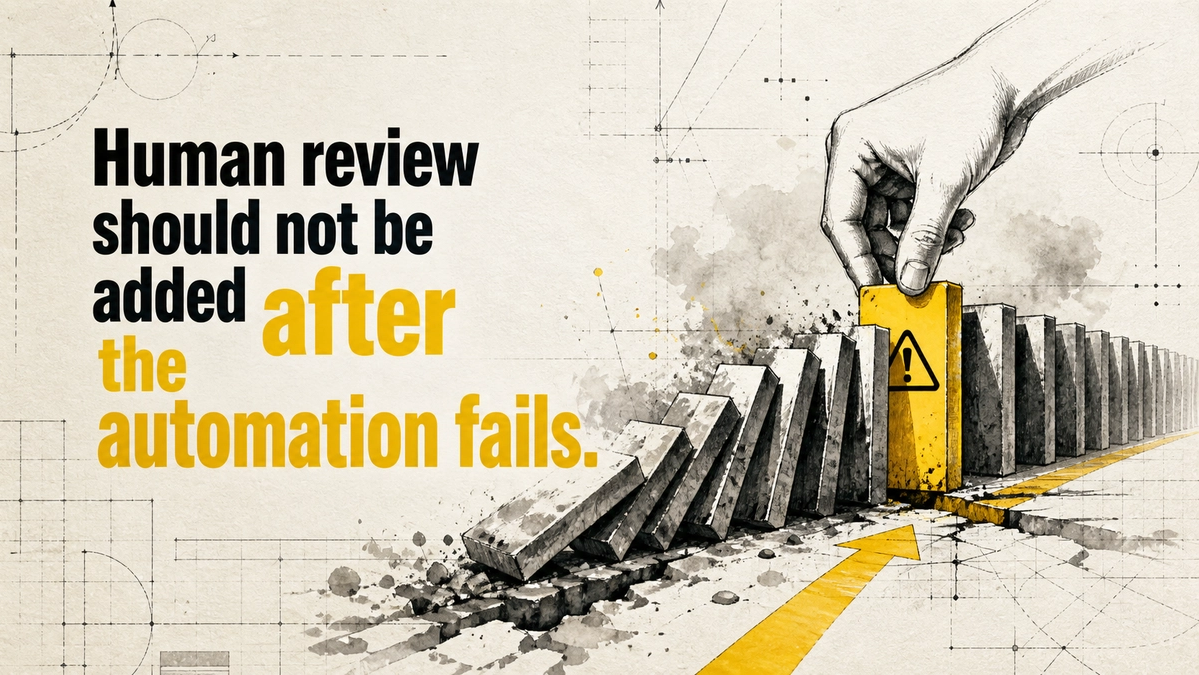
Human oversight works only when it is designed before an automation goes live: which decisions need a person, who that person is, how fast they must respond, what they can override, and how every intervention is logged. Bolting a reviewer on after the first failure leaves teams improvising at the worst possible moment.
The cost of getting this wrong is real. In 2024, a Canadian tribunal held Air Canada liable for incorrect information its website chatbot gave a customer and rejected the argument that the chatbot was a separate entity responsible for its own answers [1]. Whatever your automation says or does, your business owns it.
Three Levels of Human Oversight
| Model | How it works | Best for |
|---|---|---|
| Human in the loop | A person approves each output before it takes effect | Payments, refunds, customer commitments, legal or medical content |
| Human on the loop | The system acts on its own; a person monitors and can step in | High-volume, low-risk tasks with clear alerts |
| Human after the loop | The system acts; people review samples and logs later | Routine, easily reversed tasks such as tagging or internal routing |
Most real workflows mix all three. A support system might tag tickets automatically (after the loop), send standard answers with monitoring (on the loop), and require approval for refunds (in the loop).
How to Design Oversight Before Go-Live
- List every decision the automation makes. Not the steps, the decisions: approve, reject, reply, route, charge, change.
- Rate each decision by impact and reversibility. A wrong tag is cheap and reversible. A wrong refund or a misleading policy statement is not.
- Set approval triggers. Define exactly when a person must step in, such as amounts above a threshold, low confidence scores, out-of-policy requests, or complaints.
- Name the reviewer and the deadline. "The support lead reviews flagged refunds within four working hours" beats "someone will check".
- Give reviewers the power to override and stop. They must be able to reject an output, correct it, or pause the whole system.
- Log every intervention. Record what the system proposed, what the person decided, and why. That record is how you improve the system and prove accountability.
- Schedule a review. Look at override rates and errors monthly, and adjust thresholds as you learn.
Make Oversight Meaningful, Not a Rubber Stamp
Human review fails quietly when reviewers approve everything without looking. The EU AI Act names this risk directly: for high-risk AI systems, Article 14 requires oversight measures that help the people responsible remain aware of the tendency to over-rely on the system's output, known as automation bias, and that let them disregard, override, or reverse that output [2].
Practical ways to keep review real:
- Keep the volume humane. If one person must approve hundreds of items an hour, they are not reviewing, they are clicking.
- Show the reasoning. Give reviewers the source data, the rule or model output, and why the item was flagged.
- Track override rates. A near-zero rate can mean the system is excellent or that nobody is really checking. Spot-check to find out which.
- Rotate and train reviewers so oversight doesn't depend on one tired person.
Building the Escalation Path
Every flagged item needs a route. Define:
- Who is notified first, and through which channel.
- What information travels with the alert: the input, the system's proposal, and the reason it was flagged.
- How long they have before it escalates to the next level.
- What the fallback is if nobody responds: hold the action, not execute it.
Research supports planning for this role rather than treating it as a temporary patch. An April 2026 MIT study of more than 20 large companies found that, across generative AI deployments, the human role usually shifted from doing the task to supervising it [3]. Supervision is a job, and it needs to be designed like one.
Do Regulations Require Human Oversight?
For some systems, yes. Under the EU AI Act, high-risk AI systems must be designed so that people can effectively oversee them while they are in use [2]. The Article 14 obligations apply from 2 December 2027 for high-risk systems listed in Annex III and from 2 August 2028 for those covered by Annex I [4].
Even where no law applies, frameworks such as the NIST AI Risk Management Framework are useful templates for structuring governance, mapping risks, and assigning responsibility [5]. This is general information, not legal advice; check what applies to your industry and market.
A One-Page Oversight Plan Template
- Automation: what it does, and which systems it touches.
- Owner: the person accountable for its results.
- Decisions and risk level: each decision, rated low, medium, or high.
- Approval triggers: the conditions that require a person.
- Reviewers and response times: who reviews what, and how fast.
- Override and stop: how to reject an output and how to pause the system.
- Logging: what is recorded and where.
- Review cadence: when thresholds and performance are reviewed.
If you are still deciding whether a process should be automated at all, start with our guide on when not to automate.
Frequently Asked Questions
What is human-in-the-loop automation?
An automation where a person reviews or approves certain outputs before they take effect. It's used for decisions that are costly, hard to reverse, or require judgement.
Which decisions should always have human approval?
Anything that commits money, makes promises to customers, changes access or permissions, or carries legal, safety, or reputational risk. Low-impact, easily reversed decisions can usually be monitored instead.
Doesn't human review slow automation down?
Only where you apply it. Reserve approval for high-impact decisions and let the rest run with monitoring. Well-placed oversight prevents the much bigger slowdowns caused by errors reaching customers.
How do we know oversight is working?
Track override rates, error rates, and response times, and spot-check approved items. If reviewers never override anything, check whether they are genuinely reviewing.
Oversight is not a brake on automation; it's what lets you trust it. Define the decisions, the people, and the escalation path before launch, and your automation can scale without surprises. If you want help designing review workflows into your automations, Website Vikreta's AI automation team can build them in from the start.
References
- McCarthy Tétrault — Moffatt v. Air Canada: A Misrepresentation by an AI Chatbot
- European Commission AI Act Service Desk — Article 14: Human oversight
- MIT Industrial Performance Center — Humans in the Loop: The evolution of work in early experiments with Generative AI (April 2026)
- EU Artificial Intelligence Act — Article 14: Human Oversight (application dates)
- NIST — Artificial Intelligence Risk Management Framework (AI RMF 1.0)
Comments
Be the first to comment.
Related reads
What Is MCP? How the Model Context Protocol Connects AI Agents to Your Tools
MCP is an open standard that lets AI agents use your apps and data through one interface. Here is how it works, where it helps, and the security risks to plan for.
How to Connect Your Business Tools with AI Automation (Without Creating a Mess)
Connecting your tools saves time only when AI is used in the right places. Here is how to plan integrations, where AI helps, and the mistakes to avoid.