
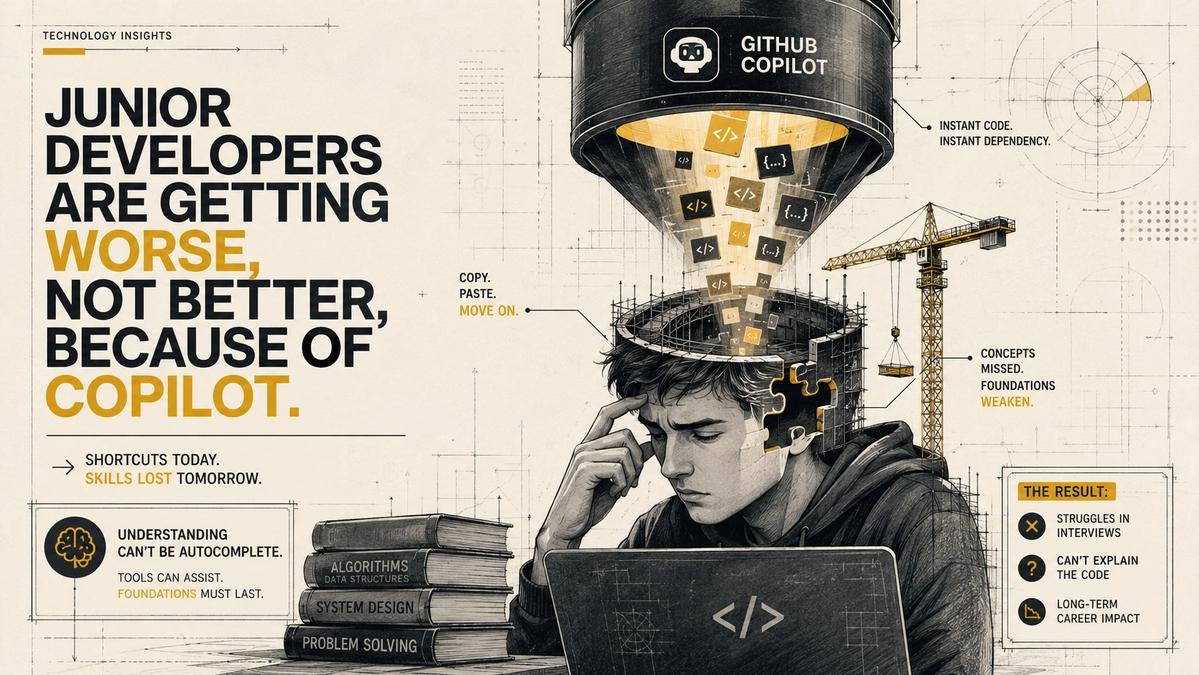

GitHub Copilot helps junior developers finish tasks faster, but studies show weaker concept retention and debugging skills. Learn why balanced AI use matters.
Faster Output Masks Shallower Understanding
Students using GitHub Copilot completed brownfield tasks thirty-five percent faster and made fifty percent more progress [4]. They spent eleven percent less time writing code manually [4]. The same groups later struggled to explain why the generated solutions worked [4]. Comprehension gaps were largest in debugging and recognizing incorrect code [4]. Speed comes from accepting suggestions. Mastery requires wrestling with the logic.
Controlled studies confirm the pattern. Performance rises while the ability to reverse-engineer or debug generated code falls [1][4]. Verification loops, where developers actively review suggestions, strongly predict better comprehension [4]. Participants who simply accepted generated blocks showed the largest gaps.
Controlled Trials Reveal the Learning Gap
In one trial of fifty-two mostly junior developers, the AI-assisted group scored fifty percent on a post-task quiz while the control group scored sixty-seven percent [4]. That difference equals nearly two letter grades. Participants who treated GitHub Copilot as a code generator rather than a tutor performed worst. Those who asked conceptual questions retained more. Across multiple studies, productivity rises while durable skill does not.
A meta-analysis of twenty-three studies found a moderate positive effect on productivity but no statistically significant improvement in learning outcomes [3]. The confidence interval for learning included zero [3]. Gains appeared mainly in controlled task settings and became less consistent in open environments.
| Group | Quiz Score | Typical Use Pattern | Outcome |
|---|---|---|---|
| Control (no AI) | 67% | Manual coding | Stronger concept retention |
| AI code generator | ~39–50% | Accept full blocks | Lowest comprehension |
| AI conceptual questions | 65–86% | Ask why and how | Better concept retention |
| Verification loops | Highest among AI users | Review every suggestion | Best skill transfer |
These figures come from randomized trials and behavioral analysis of how junior developers interact with AI coding tools [1][4].
Cognitive Disengagement Becomes the Default
Research described in an arXiv study observed students accepting suggestions without reflection [11]. They moved from one flawed AI proposal to the next instead of diagnosing root causes. Edit distances between submissions grew while score improvements shrank after AI tools became common [11]. Junior developers produced longer commits with higher churn [11]. Senior reviewers then carried more maintenance work. The short-term convenience created long-term technical debt and weaker engineering habits.
Comprehension debt builds when generated code exceeds the developer's mental model. Teams later spend more time explaining and fixing code that no one fully understands. Faster commits shift the real cost downstream.
The Productivity Argument Ignores Skill Formation
Some argue GitHub Copilot helps junior developers the most because less experienced developers show the largest time savings. Productivity studies report gains of twenty-four to fifty-five percent [3][9]. Those gains measure task completion under controlled conditions. They do not measure whether developers can later solve similar problems independently. The same meta-analysis found no statistically significant improvement in exam or learning outcomes [3]. Faster delivery today does not produce stronger developers tomorrow.
The counterargument focuses on measured speed. Junior developers do complete common patterns faster. The same groups show the largest drops on later quizzes that test debugging and root-cause understanding [4]. Speed without a solid mental model leaves them less prepared to solve unfamiliar problems.
Entry-Level Roles Shrink as Foundations Erode
Research reports that entry-level software roles have declined while demand has shifted toward more experienced developers [5][8]. Companies often view junior developers who rely heavily on AI as less prepared for independent work. The tools that increase early output also reduce the deliberate practice that once helped developers build senior-level skills. The pipeline of experienced engineers narrows over time.
Research cited by the Stanford Digital Economy Lab indicates that the decline is concentrated in work where AI automates routine tasks rather than supporting higher-value work [5]. The lower end of the experience ladder that once developed future senior engineers continues to narrow.
Deliberate Practice Must Come Before Assistance
Junior developers who write first drafts themselves and then compare them with AI suggestions retain more knowledge [4]. Turning the tool off during core learning tasks restores the productive struggle that supports learning. Teams that pair junior developers with senior engineers who model critical evaluation of AI output achieve stronger skill transfer. The technology is valuable. Treating it as a replacement for thinking produces weaker developers. The market continues to reward people who can solve problems that AI cannot.
Writing the first attempt by hand, then using AI for comparison or explanation, keeps cognitive effort high enough for learning. Teams that require developers to explain every accepted suggestion turn speed into skill instead of comprehension debt.
FAQ
Does GitHub Copilot help juniors learn new languages faster?
Exposure to new languages increases with the tool [6]. Understanding of the underlying concepts does not increase at the same rate [3][4]. Exploration grows while depth remains limited.
Can juniors use GitHub Copilot productively without skill loss?
Yes, if they treat it as a second opinion after writing their own code and explain every accepted suggestion. Accepting generated code without review weakens learning.
Why do some studies show larger gains for juniors?
Task completion speed improves more for less experienced developers because the tool supplies common coding patterns. The same groups show the largest gaps in later comprehension tests [4].
Are senior developers immune to the same problems?
No. Senior developers also need to review AI output carefully. Their existing mental models help them evaluate suggestions more effectively, which reduces the learning gap compared with junior developers [9].
What should hiring managers look for instead of AI fluency alone?
Ask candidates to debug AI-generated code, explain design choices without AI assistance, and reason through edge cases. Those abilities reveal whether genuine competence supports the speed.
How can teams reduce comprehension debt from AI use?
Require junior developers to produce a manual first draft for core tasks and document why they accepted or rejected each suggestion. Pairing with senior engineers who model the review process transfers evaluation skills more effectively.
Junior developers who rely on GitHub Copilot for every solution trade short-term speed for long-term capability. The industry needs people who can reason through problems when AI suggestions fall short. Building that ability requires deliberate practice, not constant assistance.
References
[1] Anthropic / InfoWorld — AI Use May Speed Code Generation but Developers' Skills Suffer: https://www.infoworld.com/article/4125231/ai-use-may-speed-code-generation-but-developers-skills-suffer.html
[2] Groundy — AI Pair Programming Is Creating a Junior Developer Crisis: https://groundy.com/articles/ai-pair-programming-creating-junior-developer/
[3] arXiv Meta-analysis — A Meta-analysis of the Effect of Generative AI on Productivity and Learning in Programming: https://arxiv.org/html/2605.04779v1
[4] arXiv — Fast and Forgettable, Controlled Study of Novices with Copilot: https://arxiv.org/html/2604.18538v1
[5] SSRN — AI-Assisted Development and the Reshaping of Junior Developer Roles: https://papers.ssrn.com/sol3/papers.cfm?abstract_id=6409098
[6] The New Stack — GitHub Copilot's Effect on Collaboration: https://thenewstack.io/copilot-reshapes-developer-work/
[7] MIT Sloan — Generative AI Changes How Employees Spend Their Time: https://mitsloan.mit.edu/ideas-made-to-matter/generative-ai-changes-how-employees-spend-their-time
[8] WebProNews — AI Torches Junior Coding Roles: https://www.webpronews.com/ai-torches-junior-coding-roles-while-senior-demand-holds-firm/
[9] ZDNet — The AI Coding Gap, Why Senior Developers Get Faster: https://www.zdnet.com/article/why-gen-ai-boosts-productivity-some-developers-not-others/
[10] IT Pro — Junior Software Developers Lack Coding Skills Because of Overreliance on AI: https://www.itpro.com/software/development/junior-developer-ai-tools-coding-skills
[11] arXiv — Student Behavior Study Post-ChatGPT: https://www.arxiv.org/pdf/2601.11835
Tags
Comments
Be the first to comment.
Related reads
When Not to Automate: Understanding AI Automation Limitations
Automating a broken process only accelerates failure. Before implementing AI, it’s crucial to stabilize operations, define accountability, and assess risks.

Preparing Your Team for Web AI Design Shifts: Prioritizing User Experience
In the face of rapidly evolving AI and web design technologies, prioritize user experience over simply adopting the latest tools. Discover how to prepare your team for these essential shifts.