
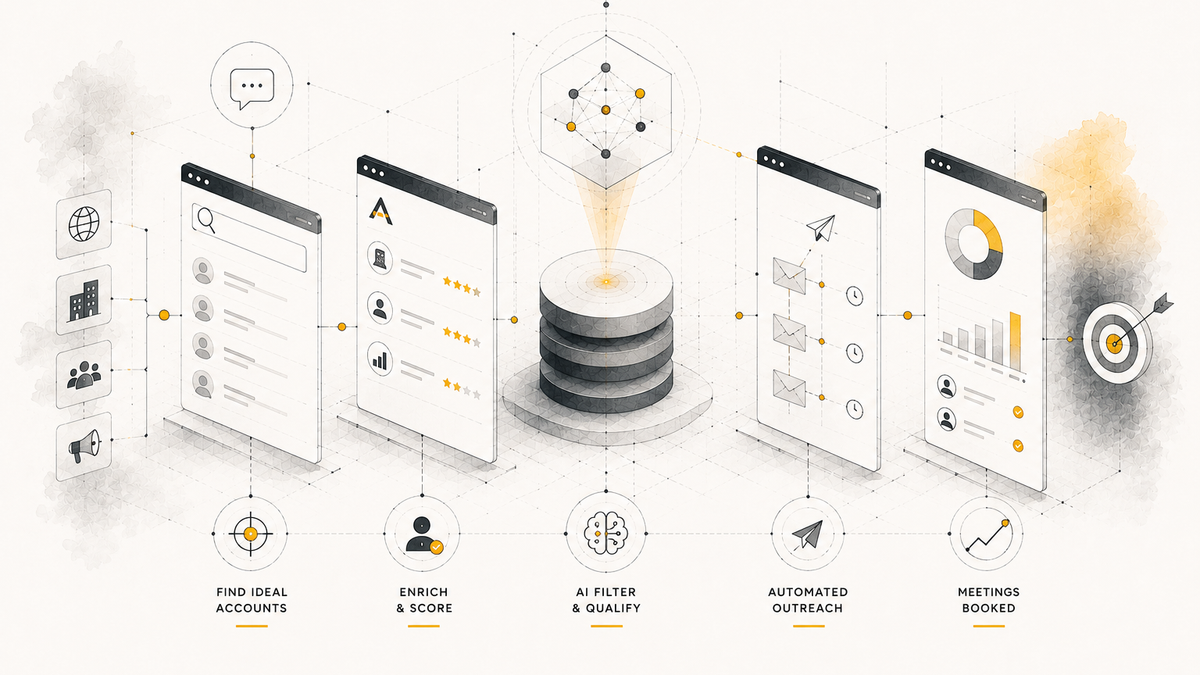
Vibe Prospecting vs. Human SDRs: Building an Automated Outbound Engine with Apollo.ai and Custom LLM Filters

Outbound prospecting used to be a numbers game played with people. A company that wanted to reach 500 accounts in a month needed a team large enough to research those accounts, find the right contacts, qualify each one, and write enough personalized outreach to actually get replies. That equation made outbound expensive and slow to scale.
AI has changed the math.
The tools available today handle most of the repetitive work that once occupied the majority of a sales development representative's day. The average SDR spends 70% of their day on tasks like prospecting, list cleaning, research, and manual follow-ups [1]. AI can absorb most of that. What remains for the human is the part that actually requires judgment: real conversations, relationship building, and closing.
The Old Way of Building a Prospect List
Before AI entered the prospecting stack, building a list meant hours of manual work.
A rep would open LinkedIn, search for companies that fit the ideal customer profile, click into each one, find the right contact, look up their email, log everything in a CRM, and repeat. For a hundred accounts, that process could take days.
Then came enrichment tools that pulled contact data automatically, followed by sequencing tools that sent follow-up emails on a schedule. Each tool solved one piece of the problem. But the stack grew fragmented. The average SDR team uses twelve tools, creating constant context switching between a list provider, an email tool, a calling app, and a CRM [2]. More tools meant more time managing integrations and less time selling.
The fundamental problem remained: someone still had to define who to target, decide which accounts mattered, and write messages that did not sound like templates.
What Vibe Prospecting Changes
The newer approach works differently from the start. Instead of building filters across multiple fields, a user describes the type of company they want to reach in plain language. "B2B SaaS companies with 50 to 200 employees that recently raised a Series A and are hiring for customer success roles" is enough to get started. The system handles the translation from description to list.
This shift matters because filter-based prospecting requires knowing exactly which fields to use, and most platforms have dozens of them. Natural language input lowers that barrier significantly and makes the first step faster for anyone on the team, not just the most technical SDR.
The output is a list of matching accounts, often generated in minutes rather than hours.
Where Apollo.io Fits In
Once a list exists, the next step is contact data and outreach. Apollo.io sits at the center of this workflow for many B2B teams. It combines automated lead generation, contact enrichment, and pre-built email workflows, allowing sales reps to focus more on conversations and closing deals rather than repetitive tasks [3]. Apollo uses machine learning to rank prospects based on engagement history, firmographic fit, and buying signals like funding rounds, recent hires, and site activity [4].
A rep does not need to manually decide which accounts to contact first. The platform surfaces the highest-priority ones based on data. The sequencing layer handles what happens next, automating outreach sequences and follow-ups through built-in email sequencing, task reminders, and multi-touch campaign workflows [3]. One user reported that after moving to Apollo, the average number of meetings booked increased by 75% and the number of call conversations over one minute doubled [5].
The LLM Layer on Top
The most powerful part of this stack is what sits above the data: a custom AI model that scores and filters accounts before a human ever sees them.
Apollo gives you a list. A large language model can read that list and apply judgment that filters cannot. It can assess whether a company's website, job postings, or recent news indicate a genuine fit for a specific offer. It can flag accounts that look right on paper but show signals that suggest poor timing. It can score 2,000 companies and surface the 80 that actually deserve attention.
By 2025, businesses were generating 30% of their outbound messages using AI, a 98% increase from 2022, according to Gartner [6]. But volume alone is not the goal. The goal is reaching the right accounts with messages that are relevant enough to earn a reply.
Outreach that references something specific to the prospect, such as a promotion, a funding round, or a published piece of content, drives open rates of 45 to 55% [7]. An LLM can research each account and pull that specific detail before the message goes out, at scale.
What the Numbers Show
The results from teams running this kind of automated outbound are measurable. Companies implementing AI prospecting report a 40% reduction in manual labor costs and a 20% increase in conversion rates [8]. Lead-to-opportunity conversion improves by approximately 20% when AI handles scoring and qualifying before a human SDR speaks with a prospect [7].
AI-augmented SDR teams close deals roughly 15% faster on average than fully human teams [7]. Faster cycles mean more deals in a given quarter without adding headcount.
The AI SDR market reflects this shift. It is projected to grow from $4.12 billion in 2025 to $15.01 billion by 2030, a compound annual growth rate of 29.5% [9]. That growth is not driven by early adopters experimenting with new tools. It is driven by teams that ran the numbers and found that AI-powered outbound outperforms the traditional model on cost, speed, and conversion.
Where Humans Still Win
None of this removes the need for people. It changes what those people do.
The highest-performing SDR teams in 2025 operate on a hybrid model: AI handles volume, prospecting, and early qualification while humans handle conversation, relationship building, and anything requiring real judgment [7]. A human rep knows when to pick up the phone instead of sending another email. They recognize when a prospect's reply signals frustration versus genuine interest. They decide when to bring in an account executive early or hold back. AI can tell you what is likely to work. Reps decide what is worth doing [10].
The accounts that convert at the highest rates still require human relationships to close. AI gets those accounts into the pipeline. People take them across the line.
What This Means for Smaller Teams
The biggest shift is not for large sales organizations. It is for small ones.
A startup with one or two people handling outbound can now research thousands of companies, identify the best-fit accounts, draft personalized first-touch emails, and run campaigns continuously without adding a single SDR. The workload that previously justified hiring a team of five now runs on a stack of tools managed by one person who reviews results, handles replies, and focuses on calls.
Win rates on deals originating from AI-initiated outreach are statistically comparable to those from human-initiated outreach as of early 2026, according to Forrester [7]. The pipeline is real. The quality holds up.
For agencies and B2B companies competing against larger teams, this is the clearest path to punching above their weight. The goal was never to remove salespeople. It was to give a small team the output of a much larger operation, and that is now possible without a large budget or a long hiring process.
References
- AiSDR — Your AI SDR That Books Meetings: https://aisdr.com/
- Martal — AI Sales Automation 2025: Top Tools & B2B Trends Revealed: https://martal.ca/ai-sales-automation-lb/
- Apollo.io — How to Build an Automated Lead Generation System: https://www.apollo.io/insights/automated-lead-generation
- PhantomBuster — Apollo.io Alternatives for Lead Gen: https://phantombuster.com/blog/ai-automation/apollo-leads/
- Apollo.io — Outbound Sales Software That Books More Meetings: https://www.apollo.io/solutions/outbound-sales-software
- SalesSo — Outbound SDR Statistics 2025: https://salesso.com/blog/outbound-sdr-statistics/
- DevCommX — 50 Key AI SDR Statistics You Should Know in 2026: https://www.devcommx.com/blogs/ai-sdr-statistics
- Zams — Best AI Prospecting Tools for SDR Teams (2025 Buyer's Guide): https://zams.com/blog/best-ai-prospecting-tools-for-sdr-teams-complete-2025-buyers-guide
- MarketsandMarkets — AI SDR Market Report 2025–2030: https://www.marketsandmarkets.com/Market-Reports/ai-sdr-market-83561460.html
- Prospectory — Outbound SDR Strategy That Wins in 2025: https://www.prospectory.ai/post/outbound-sdr-strategy-in-2025-whats-changed-what-hasnt